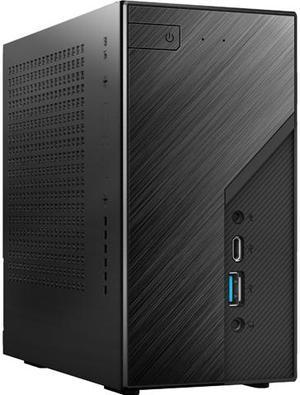
- small (about the size of a standard ATX power supply - see pics compared to modified Brix and standard OEM PSU) - compact - quiet (even under load, when paired with an aftermarket CPU cooler) - CPU, memory, storage, wifi/BT upgradeable - supports up to a Ryzen 7, 4750G (if you can find one on the gray market) - supports up to 64GB of 3200Mhz DDR4 - supports 2x m.2 PCIe 3.0 x4 slots (used WD Black NVMe PCIe 3.0x4, Windows installed in less than 5 mins from USB 3.0 stick) - supports 2x SATA III ports - supports WIFI/BT via m.2 slot - supports aftermarket CPU cooler up to 46mm (Noctua NH-L9a-AM4 is probably best solution) - has two 4pin PWM Fan ports on the motherboard - has 3 USB 3.0, 1x USB C, and 2x USB 2.0 (via optional cable) - supports up to three monitors via VGA, Displayport 1.2, and HDMI - Supports 4K UHD on Displayport and HDMI [UPDATED 3/15/2022: I upgraded the BIOS to version 1.70 (you MUST do this if you want to upgrade your unit to the latest processors BEFORE you replace the processor, although ASRock appears to offer a quick solution to upgrade the BIOS if you are not able to do it first or you just bought this and a new processor with an older BIOS), replaced the Ryzen 5-3400G with a Ryzen 7, 5700G and replaced the 16GB of RAM with 32GB of GSkill RAM. See what I mean about upgradable? Although the Ryzen 5700G uses a Vega 8 compared to the Vega 11 in the 3400G, it still performs better than the Vega 11 due to improvements in architecture and specs. The 5700G is 8 cores, 16 threads and I am now able to Play Diablo 2 Resurrected on the X300w at 1080P, medium to high graphics settings. I also did this to get some extra cores and memory for my VMware virtual machines. WOAH! It is a such a powerful package in a small case. Its quiet, doesnt generate a lot of heat, plays games like you would expect with the Vega 11 GPU on the 3400G. USB 3.0 and SSD speeds are great I didnt officially test them, but based that assessment on how little I have to wait to complete disk or USB media operations. With the L9a cooler, USB optional cable, memory, and the WD SSD, I spent about $520 + tax. For that, I got a machine that met all my needs its quiet, 4 cores, 8 threads, Vega 11 graphics, plays Minecraft, Diablo 2, No Mans Sky, plays MP3s, surfs the web, scans and prints documents, plays/streams movies in high def (and 4K if you have a 4K screen), can attach up to 3 monitors with: - VGA (1920x1200@60hz) - Display Port (1.2 4Kx2K@60hz) - HDMI (4Kx2K@60hz) - support 4K UHD with HDMI and Displayport ...runs VMware, reads external media and hard drives, charges devices, and has Wifi/BT. Unlike Brix or NUCs, I can change out the processor in the future, up to Ryzen 7, 4750G (8 cores, 16 threads, 65w, Vega 8 (comparable to a 1050) [update 3/15/2022: you can now upgrade up to a AMD Ryzen 7, 5700G but you will need BIOS version 1.70), I can upgrade to 64GB of 3200mhz RAM, I can add up to 2x m.2 NVMe (maybe non-NVMe too, didnt test that) SSD drives, and up to 2x SATA III drives for a total of 4x storage ports this is the perfect non-external GPU solution you could buy for the needs I outlined above. You might be able to add an external graphics card by using a m.2 wifi to external graphics card module, external power, and maybe up to a 1650 Nvidia, (PCIe 3.0 x1 max transfer rate), but Ive not seen that done on this box (seen it done on the BRIXs, but its possible). This was well worth the money and will be happy to use this as my daily personal machine. Granted, a laptop could have provided a more portable experience, but I dont need portability, and a laptops cooling solution is either non-existent or too loud, has limited expansion (compared to the X300), and has a bigger foot print because of the keyboard and monitor. The X300 fits all my needs from placement and size, to sound levels, heat (or lack of heat) generation, and usability. I would definitely buy another one of these should I find another use for one in the future.