


Shipped by Newegg



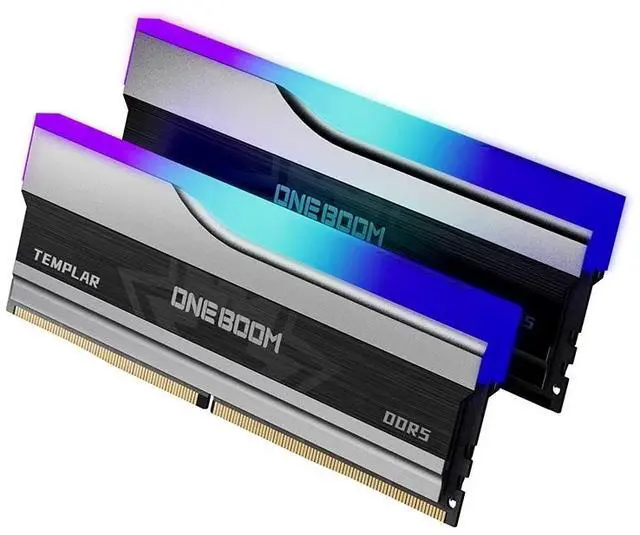
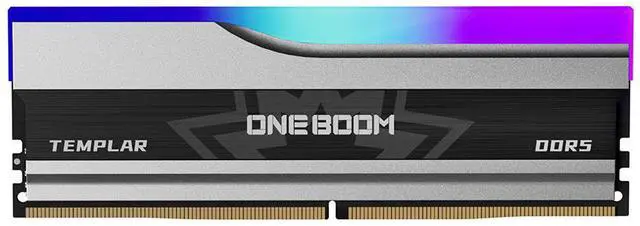
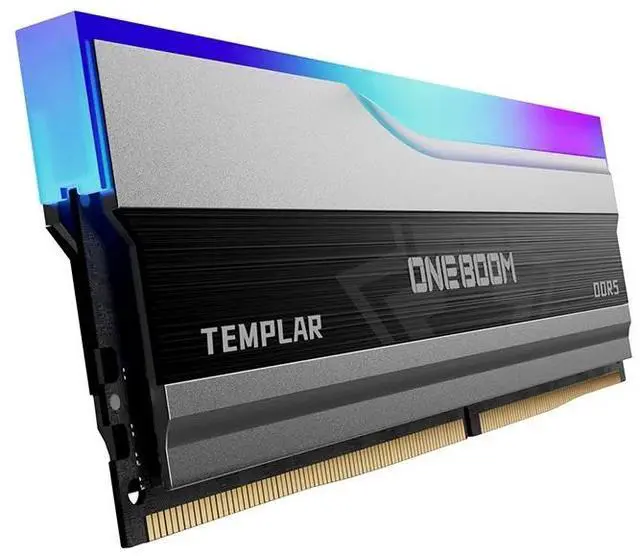
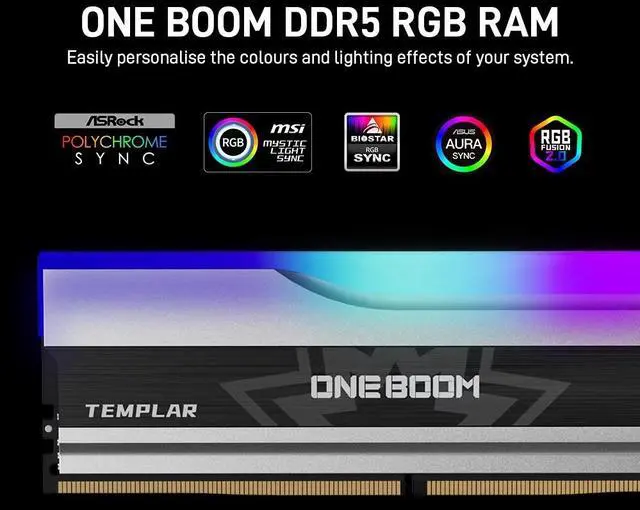
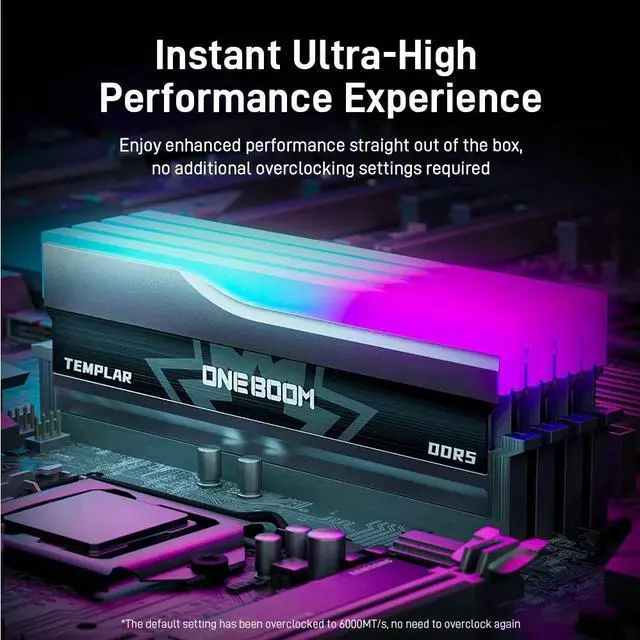
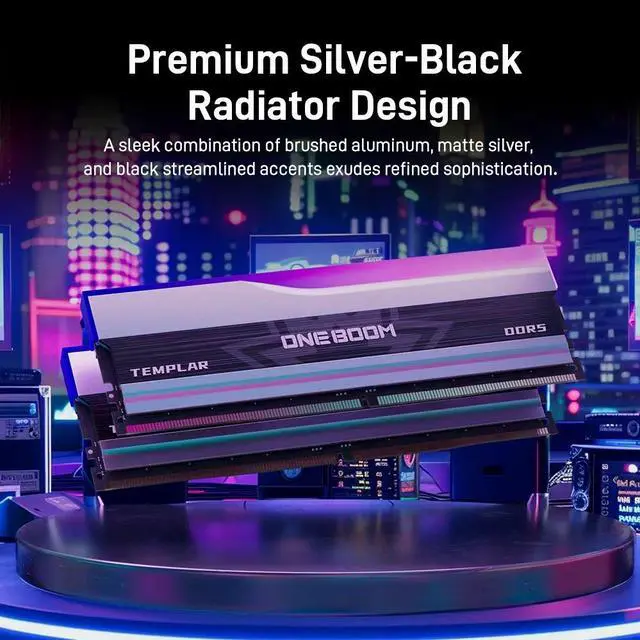
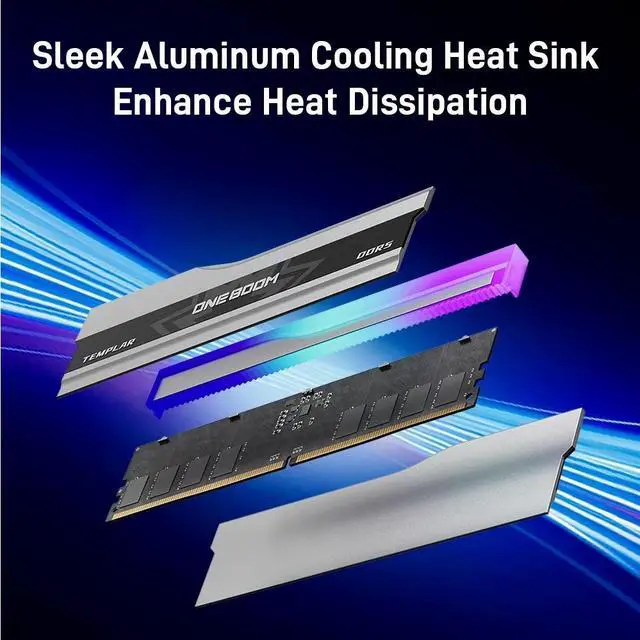
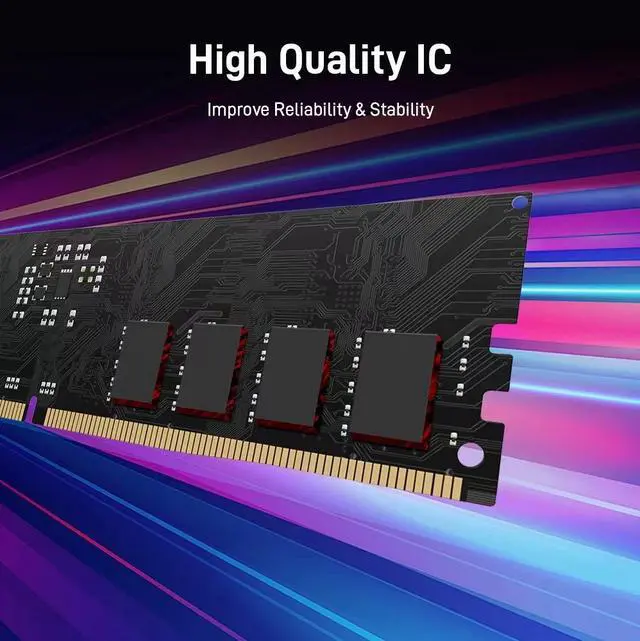


Unleash the Power of the Paladin: KingSpec OneBoom Templar DDR5 RGB Gaming Memory
Elevate your gaming rig to legendary status with the KingSpec OneBoom Templar DDR5 RGB Desktop Memory. Inspired by the unbreakable shield and glowing sword of a holy knight, the Templar series combines breathtaking next-gen speed with a stunning, personalized visual experience. Engineered for hardcore gamers, overclockers, and PC enthusiasts, this DDR5 memory kit delivers the ultra-low latency and massive bandwidth required to dominate modern AAA titles and intensive multitasking.
Key Features:
- Vibrant & Synchronized Dynamic RGB: Features a high-transmittance, wide-angle full-color RGB light bar that provides smooth, fluid lighting gradients. It seamlessly syncs with major motherboard software (ASUS Aura Sync, MSI Mystic Light, Gigabyte RGB Fusion, ASRock Polychrome), letting you customize your setup's look with one click.
- 6000MHz High-Speed Performance: Boasting a 6000MHz frequency, this memory kit provides a massive boost in bandwidth and data transfer rates compared to standard memory. Say goodbye to frame drops, loading lag, and processing bottlenecks.
- Premium "Templar Armor" Heat Spreader: Wrapped in a custom-designed, high-density aluminum heatsink. The aggressive knight-armor design not only looks fierce but also maximizes thermal dissipation, keeping your memory cool and stable.
- Effortless One-Click Overclocking: Fully compatible with Intel XMP 3.0 and AMD EXPO. Unleash the rated 6000MHz speed instantly right out of the BIOS without manual adjustments.
- Next-Gen Reliability: Equipped with an integrated Power Management IC (PMIC) for precise power distribution and rock-solid power stability at 1.35V under heavy workloads.
We want to ensure your holiday shopping this year is hassle-free. That’s why we’re automatically extending our return policies on almost every product! For purchases placed between November 1st, 2026 and December 31, 2026 you will have until January 31, 2027 to return your product.
The KingSpec ONEBOOM Templar DDR5 RGB 32GB kit is a 2x16GB DDR5-6000 CL30 desktop memory set built for gamers and PC enthusiasts who want fast performance, Intel XMP 3.0 and AMD EXPO support, and synchronized RGB lighting in a modern custom build.
| Attribute | Value |
|---|---|
| Best For | Desktop gaming and enthusiast PCs that need a 32GB (2 x 16GB) DDR5 6000 288‑pin memory kit with RGB lighting and one‑click overclocking support (Intel XMP 3.0 / AMD EXPO) |
| Capacity | 32GB kit (2 x 16GB) |
| Memory Type And Speed | DDR5 6000 (PC5‑48000), 288‑pin desktop DIMM |
| Timings And Latency | CAS Latency CL30 with 30‑36‑36‑76 timing sequence |
| Voltage And Power | 1.35V operating voltage |
| Module And Form Factor | 288‑pin DIMM module, unbuffered, non‑ECC |
| Compatibility And Profiles | Supports Intel XMP 3.0 and AMD EXPO one‑click profiles; recommended for RGB sync with ASUS Aura, MSI Mystic, Gigabyte Fusion, and ASRock Polychrome |
| Thermal And Lighting | High‑density aluminum armor heat spreader in black/gray with RGB lighting (LED Color: RGB) |
| Model Identifiers | KingSpec ONEBOOM model OB6000D5R13516G |
Q: Should I buy this DDR5-6000 CL30 32GB kit or a cheaper DDR5-5600 kit?
A: Choose this 32GB DDR5-6000 CL30 kit if you want a stronger performance-oriented baseline for a modern gaming desktop, especially on AMD AM5 where DDR5-6000 is widely treated as the practical target speed for EXPO memory setups. A DDR5-5600 kit is the better fit when the goal is lower cost and you do not mind giving up some memory bandwidth and latency. In short: 5600 is the value option, while this 6000 CL30 kit is the better choice for buyers trying to avoid a near-term RAM upgrade.
Q: Is this KingSpec 32GB DDR5-6000 CL30 kit a better pick than a mainstream 32GB DDR5-6000 CL30 kit from Corsair or G.Skill?
A: Buy this KingSpec kit when the deciding factors are the rated spec, RGB styling, and getting 32GB DDR5-6000 CL30 with both XMP 3.0 and EXPO support. A Corsair or G.Skill alternative is the safer choice if you place more value on broader brand recognition, longer review history, and more widely documented platform validation. Performance at the same 6000 CL30 class should be similar once profiles are loaded, so the real trade-off is price-and-features versus brand confidence and ecosystem maturity.
Q: Should I get 32GB like this kit or move up to 64GB DDR5?
A: Choose this 32GB kit if your system is mainly for gaming, general desktop use, and typical streaming or multitasking. Move to 64GB if you regularly work with heavier creator workloads, large project files, virtual machines, or you want more headroom for long-term multitasking. The trade-off is straightforward: 32GB is the more balanced capacity for most gaming builds, while 64GB is the better fit when workload size matters more than budget discipline.
Q: Is DDR5-6400 a better buy than this DDR5-6000 CL30 kit?
A: Buy DDR5-6400 if you are comfortable spending more time on platform tuning and you are specifically chasing incremental gains on a compatible board and CPU. Choose this DDR5-6000 CL30 kit if you want the more practical balance of speed, latency, and setup simplicity. Across buyer guides and platform guidance, 6000-class CL30 memory is commonly treated as the easier high-performance target, while 6400 is more of an enthusiast step than a necessary upgrade.
Q: Should I choose this DDR5 kit or keep an older DDR4 setup?
A: Choose this DDR5 kit if you are building on a current DDR5 platform or planning a broader platform upgrade. Keep DDR4 only if you are staying on an existing DDR4-compatible motherboard and want to control total upgrade cost. The main trade-off is platform age versus total spend: DDR4 can still make sense for extending an older system, but DDR5 is the more appropriate match for current AMD AM5 builds and most new Intel DDR5-focused builds.
Q: Is this RAM a good fit for a mid- to high-end gaming PC build in 2026?
A: Yes, if your motherboard supports DDR5 and can run a 6000 MT/s XMP or EXPO profile. A 32GB (2x16GB) DDR5-6000 CL30 kit is a strong mainstream gaming configuration because it offers high bandwidth, relatively tight timings for this speed class, and dual-channel capacity that suits modern games and multitasking. The main requirement is platform compatibility: this is desktop UDIMM DDR5, not laptop memory, and real-world support still depends on the motherboard BIOS and QVL.
Q: Will it work on both AMD and Intel systems?
A: Usually yes, but only if the board supports DDR5 UDIMM memory and the kit is on, or close to, the board's validated memory support. This KingSpec kit includes both Intel XMP 3.0 and AMD EXPO profiles, which is a practical advantage over kits that emphasize only one profile. Even so, repeated retail Q&A for comparable DDR5-6000 kits shows that buyers frequently need to verify motherboard QVL support rather than assuming any DDR5 board will run the rated profile.
Q: If my motherboard only supports 5600 MT/s, can I still use this 6000 MT/s kit?
A: Yes, it will often still work, but you should expect it to run at the board or CPU's supported speed unless your platform can successfully enable the 6000 MT/s profile. In practice, this means the kit is usable as standard DDR5 memory, but buying a 6000 CL30 kit makes the most sense when your board and CPU are known to handle DDR5-6000 stably. Retail compatibility questions for comparable kits repeatedly center on this exact trade-off.
Q: Is this better than a cheaper DDR5-6000 CL36 kit?
A: For buyers choosing between otherwise similar 32GB DDR5-6000 RGB kits, this CL30 specification is the stronger performance-oriented option on paper because it has tighter primary latency than CL36 at the same data rate. The trade-off is value: a cheaper CL36 kit may be the more practical choice for budget-focused builds, while this kit makes more sense for users who want a faster-timed 6000 MT/s setup with RGB and dual XMP/EXPO support.
Q: Who is this RAM most suitable for, and who should skip it?
A: It is most suitable for desktop gamers and PC builders who want 32GB capacity, DDR5-6000 speed, RGB lighting, and easy BIOS tuning through XMP or EXPO. It is less suitable for buyers who need guaranteed plug-and-play behavior on older or entry-level boards, need workstation ECC memory, or are building a laptop or small-form-factor system that uses SODIMM instead of full-size desktop UDIMM modules.
Q: Is this a good DDR5 kit for a mainstream gaming PC build?
A: Yes, if your goal is a 32GB DDR5-6000 kit with RGB and broad platform support. The listed specs are strong for current gaming builds: 2x16GB capacity, DDR5-6000 speed, CL30 timings, and both Intel XMP 3.0 and AMD EXPO support. Reddit discussions around this product line show it commonly appears in midrange and upper-midrange gaming prebuilts, which suggests it fits that use case well. The main trade-off is brand confidence versus better-known memory brands, not the core spec sheet itself.
Q: Who is this RAM most suitable for?
A: It is most suitable for gamers and general desktop users building a DDR5 system who want 32GB, RGB lighting, and simple BIOS setup through XMP or EXPO. Its 2x16GB layout is a practical fit for modern gaming and multitasking. It is less clearly suited for buyers who prioritize workstation-grade validation, ECC support, or a long track record from a top-tier memory brand.
Q: What are the main trade-offs compared with better-known DDR5 kits?
A: The main trade-off is confidence, not basic functionality. On paper, this kit is competitive because DDR5-6000 CL30 is a strong spec for gaming, and it supports both EXPO and XMP. In community discussion, the hesitation is usually about lesser-known memory brands, possible variation in supplied timings across related OneBOOM kits, and whether buyers would rather pay more for a brand with a longer reputation in RAM. If you value established brand history and easier resale, a more familiar kit may be the safer choice.
Q: Is this a better fit for value buyers or for performance tuners?
A: It is a better fit for value-oriented buyers who want solid out-of-box DDR5 performance with RGB. The product information emphasizes one-click XMP/EXPO setup rather than manual tuning, and community discussion around similar kits focuses more on getting acceptable 6000MT/s memory at a reasonable cost than on advanced overclocking headroom. If your priority is manual memory tuning, detailed QVL validation, or premium binning, a more established enthusiast kit may be a better match.