


- Free 30-day Returns
$2,099.99
Add to PC build list
Ships from United States.
Sold by Newegg
Shipped by Newegg




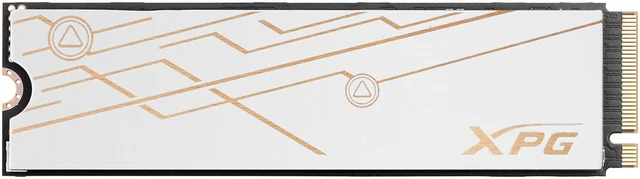
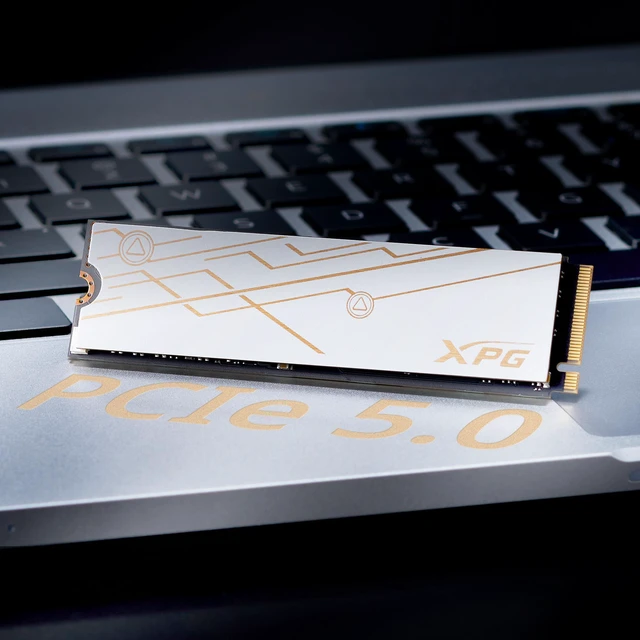


XPG BLADE M.2 2280 8TB PCI-Express 5.0 x4 3D NAND Internal Solid State Drive (SSD) with DRAM Cache, Speed up to 14000mb/s SMAR-980B-8TCS
- PCIe Gen5 x4 transmission interface
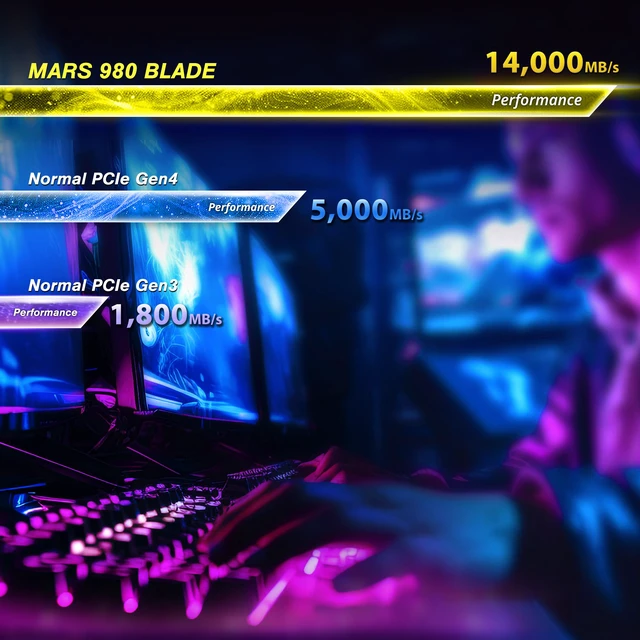
- Up to 14,000/13,000MB/s sequential read/write speed
- Aluminum alloy and turbo fan form an active air-cooling system
- Compared with a fanless heatsink, temperatures significantly reduced by 15%
- Active cooling is powered directly from the M.2 slot, no additional charging cable needed
- 8TB capacity
- Supports latest Intel and AMD platforms
+
+
Overview
Specs
Reviews (7)
Overview
The XPG MARS 980 BLADE is an 8TB internal solid state drive for consumer use. It combines an M.2 2280 form factor, PCI-Express 5.0 x4 interface, NVMe 2.0 protocol, and 3D NAND memory components.
Key Features
- 8TB storage capacity
- M.2 2280 form factor with heatsink
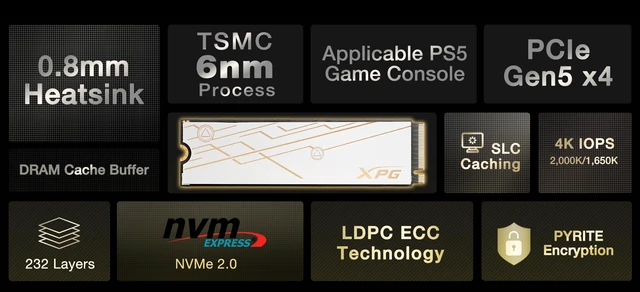
- PCI-Express 5.0 x4 interface and NVMe 2.0 protocol
- Up to 14,000 MB/s sequential read and 13,000 MB/s write speeds
- Up to 1,850,000 4KB random read IOPS and 1,800,000 4KB random write IOPS
Performance
The drive delivers maximum sequential read speeds of up to 14,000 MB/s and maximum sequential write speeds of up to 13,000 MB/s. Rated 4KB random performance reaches up to 1,850,000 IOPS for reads and up to 1,800,000 IOPS for writes.
Design
The drive uses an M.2 2280 form factor and includes a heatsink. Its memory components are 3D NAND, and the controller is an SMI SM2508.
Connectivity & Compatibility
The internal SSD uses a PCI-Express 5.0 x4 interface and NVMe 2.0 protocol. The listed form factor is M.2 2280.
Reliability & Durability
The drive is rated for 5,920TB total terabytes written. Operating temperature is 0°C to +70°C, storage temperature is -40°C to +85°C, and maximum shock resistance is 1500G.
Specifications
- Brand: XPG
- Series: BLADE
- Model: SMAR-980B-8TCS
- Device Type: Internal Solid State Drive (SSD)
- Used For: Consumer
- Form Factor: M.2 2280
- Capacity: 8TB
- Memory Components: 3D NAND
- Interface: PCI-Express 5.0 x4
- Protocol: NVMe 2.0
- Controller: SMI SM2508
- Max Sequential Read: Up to 14,000 MB/s
- Max Sequential Write: Up to 13,000 MB/s
- 4KB Random Read: Up to 1,850,000 IOPS
- 4KB Random Write: Up to 1,800,000 IOPS
- Terabytes Written (TBW): 5920TB
- Heatsink: With heatsink
- Operating Temperature: 0°C to +70°C
- Storage Temperature: -40°C to +85°C
- Max Shock Resistance: 1500G
Warranty & Returns
Warranty, Returns, And Additional Information
Warranty
- Limited Warranty period (parts): 3 years
- Limited Warranty period (labor): 3 years
- Read full details
Return Policies
- Return for refund within: 30 days
- Return for replacement within: 30 days
- This item is covered by Newegg.ca's Standard Return Policy.
- Read full return policy for details.
Manufacturer Contact Info
- Manufacturer Product Page
- Manufacturer Website
- Support Phone: 1-714-332-8708
- Support Email: [email protected]
- Support Website
- View other products from ADATA
LOADING...
The XPG BLADE SMAR-980B-8TCS is an 8TB M.2 2280 PCIe 5.0 x4 NVMe SSD with DRAM cache and a heatsink, suited to gamers and creators who need high-speed storage for large game libraries or demanding workloads on compatible systems.
Recommended For
- Desktop users with a PCIe 5.0 x4 M.2 slot who want one high-capacity drive for the operating system, applications, and active project files; a review of the MARS 980 BLADE found especially strong random-write performance, though it tested a smaller-capacity model.
- Laptop owners with a compatible M.2 2280 PCIe 5.0 slot and enough space for the drive’s heatsink who need up to 8TB of internal storage for games, media, or work files.
- PC builders who need a large, high-endurance library or project drive: XPG rates the 8TB model for up to 5,920TB written, making its capacity and rated write endurance relevant to frequently updated local data.
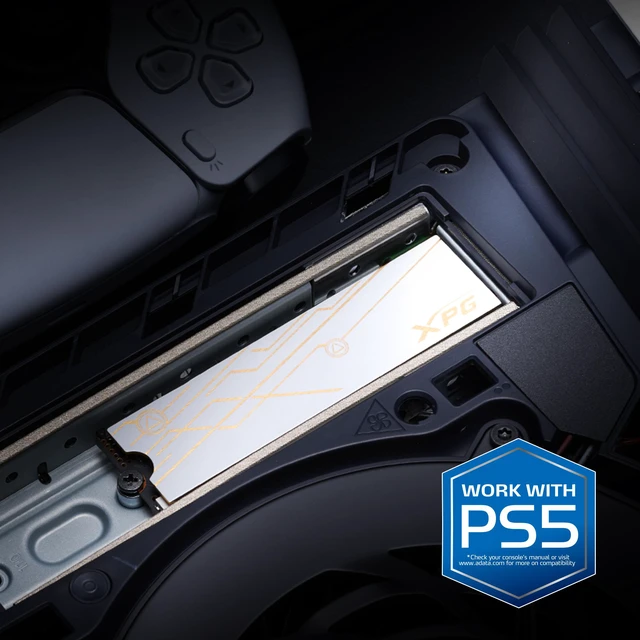
- PS5 owners seeking an 8TB M.2 expansion drive, provided the drive and heatsink fit the console’s clearance requirements; Sony lists support for up to 8TB and requires effective heat dissipation.
Real-World Use Scenarios
- As a Windows system drive, it suits a high-end PC where the user wants responsive everyday startup and app activity; a review found especially strong small-file performance, though the benefit depends on the rest of the system.
- For a large PC game library, the 8TB capacity can reduce the need to uninstall games to make room for new ones; testing covered game loading, installs, and gameplay-related storage tasks, but does not establish that every game will load noticeably faster.
- When editing or managing large media projects, it can serve as a roomy working drive for footage, source files, and exports; reviews report good sustained-write behavior, while actual transfer times also depend on the source drive and workload.
- For a gaming laptop upgrade, it offers a single M.2 2280 drive with substantial storage for games and applications; check that the laptop supports PCIe Gen5 and that the drive’s heatsink fits the available slot and cooling arrangement.
- For frequent large file copies or game recordings, it can be used as a high-capacity working or capture drive; reviews found strong sustained writes in testing, but copying speed will still be limited by the other drive, interface, and file workload.
Spec Summary
| Attribute | Value |
|---|---|
| Best For | Consumer systems needing high-capacity internal storage, including gaming and laptop use |
| Capacity | 8TB for large applications, games, and other files |
| Interface And Form Factor | M.2 2280 drive using PCIe 5.0 x4 with NVMe 2.0 |
| Controller And Memory | SMI SM2508 controller with 3D NAND, DRAM cache, and SLC caching |
| Read Write Performance | Sequential speeds up to 12,000 MB/s read and write; 4KB random performance up to 1,850,000 IOPS read and 1,800,000 IOPS write |
| Endurance | Rated for 5,920 TBW |
| Thermal And Shock Specifications | Includes a heatsink; operating temperature 0°C to +70°C, storage temperature -40°C to +85°C, and shock resistance up to 1,500G |
| Security And Error Correction | Supports Pyrite encryption and LDPC error correction |
| Model Identifiers | XPG BLADE series, model SMAR-980B-8TCS |
Reference Q&A
Q: XPG MARS 980 BLADE 8TB or Samsung 9100 PRO 8TB—which should I choose?
A: Choose the XPG if its price and published endurance rating are the priority: ADATA lists 5,920 TBW for the 8TB MARS 980 BLADE. Choose the Samsung if you prioritize higher rated peak sequential speeds: Samsung specifies up to 14,800/13,400 MB/s read/write, versus ADATA’s published MARS 980 BLADE series figures of up to 14,000/13,000 MB/s. These are manufacturer maximums, not guaranteed real-world transfer speeds; compare current prices and confirm the motherboard or laptop has adequate M.2 cooling.
Q: Is the XPG MARS 980 BLADE worth choosing over a PCIe 4.0 Samsung 990 PRO?
A: Choose the 8TB MARS 980 BLADE if you need its larger capacity or regularly move large files and have a PCIe 5.0-capable system. The 990 PRO is a PCIe 4.0 drive rated up to 7,450/6,900 MB/s, so its sequential-speed ceiling is lower. For everyday booting and gaming, the interface generation alone does not establish a meaningful improvement in every workload; consider the 990 PRO if it meets your capacity needs at a better price.
Q: Should I get the XPG MARS 980 BLADE or the lower-tier MARS 970 PLUS?
A: Choose the MARS 980 BLADE if you want the higher published performance tier or need an 8TB option. ADATA lists the 980 BLADE at up to 14,000/13,000 MB/s and the 970 PLUS at up to 11,000/10,000 MB/s; the 970 PLUS is the more suitable choice if its available capacity and rated speeds are sufficient. Check the exact model and capacity before buying, since the listed capacities differ between the lines.
Q: Should I buy the 8TB MARS 980 BLADE or a smaller 4TB version?
A: Choose 8TB if you expect to keep a large game library, media projects, or other sizable files on one drive; choose 4TB if that capacity is enough and the lower purchase cost matters more. Capacity alone does not establish that the 8TB model will be faster in typical use. The reviewed MARS 980 BLADE 2TB performed strongly in random-write testing, while PCWorld found its real-world large-file transfer results broadly competitive; those results are from a different capacity, not a direct 8TB-versus-4TB test.
Q: Will this SSD fit and work in my laptop?
A: It is an M.2 2280 PCIe NVMe drive, but fit depends on the laptop’s supported drive type, capacity limits, and physical clearance for the included heatsink. Check the laptop’s specifications or service manual before buying; an M.2 slot alone does not confirm compatibility.
Q: Will it work in a PCIe Gen 4 M.2 slot?
A: The drive uses PCIe 5.0 x4, and its listed maximum speeds require a compatible PCIe 5.0 x4 system. The supplied specifications do not confirm operation in a Gen 4 slot, so check the motherboard or laptop documentation and drive compatibility information before purchase.
Q: Is this SSD a good choice for gaming and large files?
A: It offers 8TB of capacity and listed sequential read and write speeds of up to 12,000 MB/s, making it suitable for systems that support PCIe 5.0 x4 and users who need substantial storage or fast large-file transfers. Actual performance depends on the host system and workload.
Q: Is 8TB worthwhile for everyday office use?
A: It may be more capacity and performance than basic office tasks require. The 8TB capacity is useful if you keep large files, applications, or game libraries on one drive; choose it based on your storage needs and whether your system supports its interface.
Q: Is the MARS 980 Blade worth choosing over a Gen4 SSD for Windows and games?
A: Its listed sequential speeds are up to 12,000 MB/s, but Reddit discussions comparing it with Gen4 drives note that everyday operating-system and gaming use may not benefit much from the extra throughput. It is a better fit when you also need 8TB of capacity or regularly move large files; otherwise, compare prices before paying more for Gen5.
Q: Should I use the drive’s heatsink or my motherboard’s M.2 heatsink?
A: The product listing says this drive includes a heatsink, and Reddit users have raised the same choice when installing the MARS 980 Blade. Check your motherboard’s manual and available clearance to confirm which cooling solution fits; do not assume both can be stacked.
Q: Is the MARS 980 Blade suitable for video editing and 3D work?
A: Its PCIe 5.0 interface and listed sequential speeds of up to 12,000 MB/s may suit workflows involving frequent large-file transfers. A Reddit PC-build discussion lists Premiere, After Effects, Maya, Substance Painter, and ZBrush as intended uses for another MARS 980 Blade build; actual benefit depends on the workload and system support.