






We want to ensure your holiday shopping this year is hassle-free. That’s why we’re automatically extending our return policies on almost every product! For purchases placed between November 1st, 2026 and December 31, 2026 you will have until January 31, 2027 to return your product.
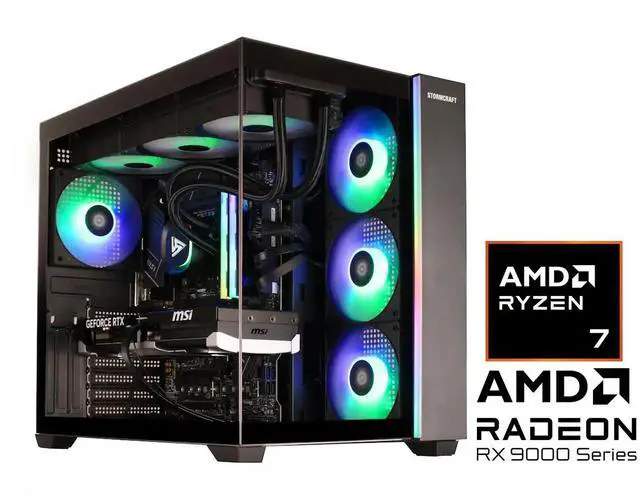
The STORMCRAFT FALCON is a prebuilt gaming desktop with a Ryzen 7 7800X3D, Radeon RX 9070 XT 16GB, 32GB DDR5, and a 1TB Gen4 NVMe SSD, making it a strong fit for gamers who want high-refresh 1440p play, VR readiness, and a turnkey Windows 11 setup with keyboard and mouse included.
| Attribute | Value |
|---|---|
| Best For | Gaming and entertainment consumers who want a desktop configured with an AMD Ryzen 7 7800X3D CPU and AMD Radeon RX 9070 XT 16GB GPU |
| Processor And Core Count | AMD Ryzen 7 7800X3D (AMD Ryzen 7 7000 Series), 64-bit 8‑core processor with 8 MB L2 and 96 MB L3 cache |
| GPU And VRAM | AMD Radeon RX 9070 XT graphics with 16 GB dedicated video memory |
| Memory Configuration | 32 GB DDR5 system memory |
| Storage And Expansion | 1 TB SSD internal storage |
| Cooling And Thermal | 360 mm AIO liquid cooling |
| Power And PSU | 850 W 80+ Gold power supply |
| Motherboard And Chipset | Motherboard model B650 with chipset listed as Z790 |
| Case And Build | Black case color |
| Peripherals And Accessories | Includes keyboard and mouse |
| Model Identifiers | Stormcraft FALCON — Part Number FA780XDCB-97BN1 |
Q: Should I choose this Ryzen 7 7800X3D + Radeon RX 9070 XT desktop or a similar prebuilt with an RTX 5070 Ti?
A: Choose this STORMCRAFT FALCON if your priority is strong traditional 1440p or entry 4K gaming value with a gaming-focused CPU. Across multiple reviews, the RX 9070 XT typically trades closely with the RTX 5070 Ti in rasterized gaming, while the Ryzen 7 7800X3D remains a well-established gaming CPU. A 5070 Ti-based system is the better fit if you place more weight on heavier ray tracing, DLSS features, or Nvidia-specific creator and AI workflows.
Q: Is this a better buy than a lower-cost gaming desktop with a Ryzen 7 7700X or 7700X3D and a weaker GPU?
A: This system is the better choice when gaming performance is the main goal and you want fewer near-term upgrades. The Ryzen 7 7800X3D consistently benchmarks ahead of the Ryzen 7 7700X in games, and the RX 9070 XT sits in a much higher graphics tier than mainstream alternatives. A lower-cost 7700X or 7700X3D desktop makes more sense if you are targeting 1080p or moderate 1440p settings and want to reduce upfront cost.
Q: Should I buy this system or step up to a newer 9800X3D-based gaming desktop?
A: Buy this 7800X3D system if you want a high-end gaming desktop where most of the budget goes to the graphics card rather than chasing a smaller CPU uplift. Reviews commonly show the Ryzen 7 9800X3D as faster in gaming, but usually by a modest margin relative to the total system cost. A 9800X3D system is the better choice if you want the newest AM5 gaming CPU and you are trying to maximize very high-refresh performance in CPU-sensitive titles.
Q: Is this desktop a better fit than an older high-end PC built around a Ryzen 7 5800X3D or Radeon RX 7900-class GPU?
A: This desktop is the better fit if you want a current AM5 platform, DDR5 memory, and a newer GPU generation without building from parts. The Ryzen 7 7800X3D is broadly viewed as a meaningful gaming step up from the 5800X3D, and newer platform features can make future upgrades easier. An older high-end system can still be reasonable if priced much lower and you are comfortable with an older platform and fewer forward-looking features.
Q: Should I get this gaming desktop or a high-end gaming laptop if I travel often?
A: Choose this desktop if gaming performance, thermals, and upgrade flexibility matter more than portability. Desktop parts such as the Ryzen 7 7800X3D and RX 9070 XT generally deliver higher sustained performance than mobile-class hardware in similarly positioned laptops, and this system also includes standard desktop cooling and power delivery. A gaming laptop is the better choice only when you need one machine that is easy to move between rooms, homes, or events.
Q: Who is this gaming PC best suited for?
A: This PC is best for buyers who want a high-end gaming desktop first and a general-use Windows PC second. The Ryzen 7 7800X3D is widely chosen for gaming-focused builds, and 32GB DDR5 plus a 1TB NVMe SSD make it suitable for modern AAA games, esports, streaming, and everyday multitasking. It is less ideal for shoppers who mainly want a compact office PC or the lowest-cost option.
Q: Is 1TB of SSD storage enough, or should I expect to upgrade it?
A: 1TB is enough for Windows, daily apps, and a moderate game library, but many gaming PC shoppers eventually add more storage. On comparable retail Q&A pages, storage expansion is a repeated buying question. For this model, 1TB is a practical starting point, not a large long-term capacity, especially if you install many AAA games or keep large media files locally.
Q: Can this PC be upgraded later for more RAM or storage?
A: It should be a reasonable choice for buyers who want some upgrade headroom. Comparable prebuilt gaming desktop Q&A pages repeatedly focus on adding RAM or another SSD, and this model already uses a modern AM5/B650 platform, 32GB DDR5, and an ATX mid-tower layout. The main trade-off is that exact slot availability and internal layout should still be confirmed with the seller before purchase if future upgrades are a deciding factor.
Q: Is this overkill for school, office work, or basic home use?
A: Yes for most basic users. This system will handle office work, web use, meetings, and school tasks easily, but its parts are aimed at gaming performance rather than value-focused productivity. If your main workload is documents, browsing, video calls, and light multitasking, this class of desktop is more power, size, and cost than most people need.
Q: What is the main trade-off versus a similar prebuilt with more storage or an NVIDIA GPU?
A: The likely trade-off is configuration balance, not basic capability. This Stormcraft build puts strong emphasis on gaming CPU performance, 32GB of RAM, liquid cooling, and an 850W Gold PSU, but it includes only 1TB of storage. A comparable alternative may offer 2TB storage or an NVIDIA GPU, which can matter if you prioritize a larger installed game library or prefer NVIDIA-specific software features. If pure gaming-first hardware balance matters more than storage capacity, this configuration makes sense; if convenience and bigger out-of-box storage matter more, a 2TB alternative may be the easier buy.
Q: Is a Ryzen 7 7800X3D plus Radeon RX 9070 XT a good fit for 1440p gaming?
A: Yes. This CPU and GPU pairing is widely discussed as a strong 1440p combination, especially for high refresh rate gaming. The 7800X3D is gaming-focused, and the RX 9070 XT class is generally treated as more than enough for demanding 1440p use. For buyers focused mainly on gaming rather than heavy workstation workloads, this is a sensible configuration.
Q: Who is this PC best suited for?
A: This system is best suited for buyers who want a gaming-first desktop with strong out-of-box specs: Ryzen 7 7800X3D, 32GB DDR5, and an RX 9070 XT 16GB. It fits users targeting modern AAA games, high-FPS competitive gaming, VR, and general multitasking. It is less tailored to buyers who need large built-in storage or a workstation-first machine for heavily CPU-based professional workloads.
Q: What are the main trade-offs of this configuration?
A: The main trade-offs are storage capacity and upgrade value versus price. A 1TB SSD is fast and usable, but many buyers in Reddit discussions compare similar systems with 2TB drives, so frequent large-game installs may fill it quickly. The included 32GB RAM and 850W Gold PSU are positives, but value depends on the final selling price versus similar prebuilts with the same CPU and GPU.
Q: Is this worth buying instead of building a similar PC yourself?
A: It can be, but only if the prebuilt price is competitive. Reddit discussions around similar 7800X3D + RX 9070 XT systems often focus on whether the prebuilt premium is small enough to justify convenience, assembly, Windows setup, and support. If the price is close to the cost of equivalent parts, a prebuilt like this is easier and lower-effort. If the markup is large, building usually gives better storage, part choice, or overall value.