




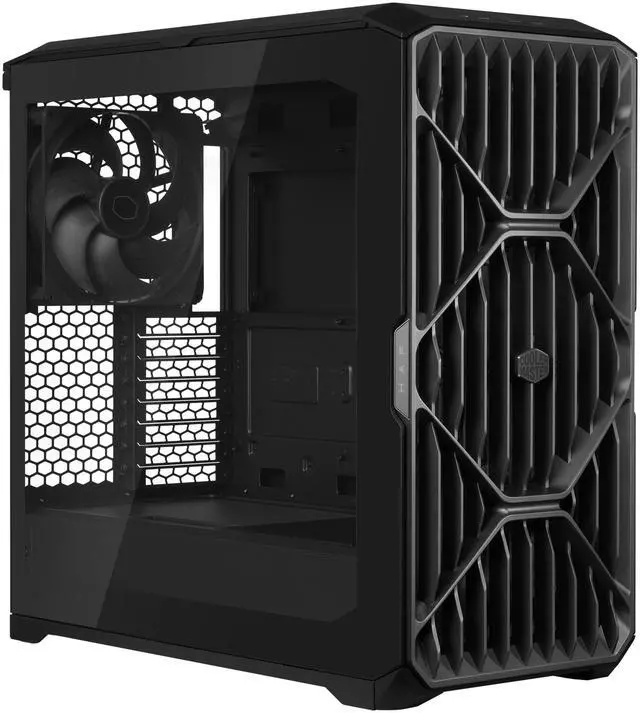
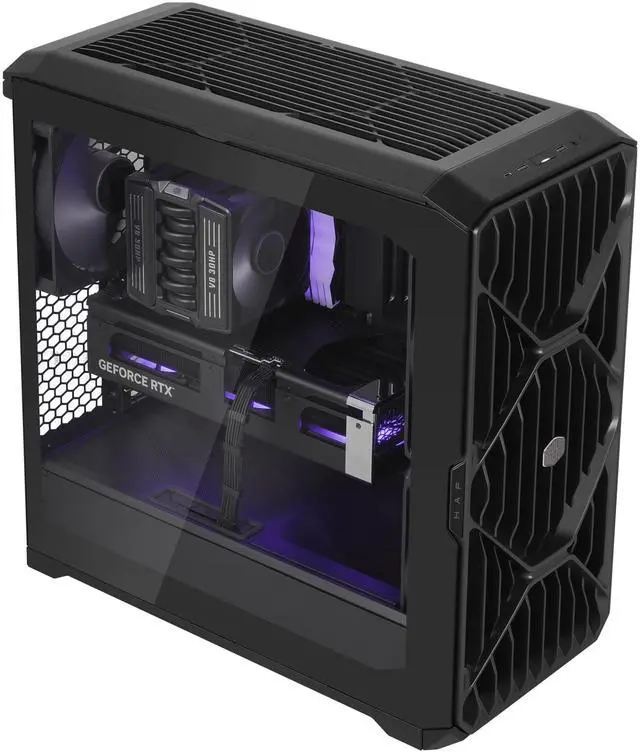
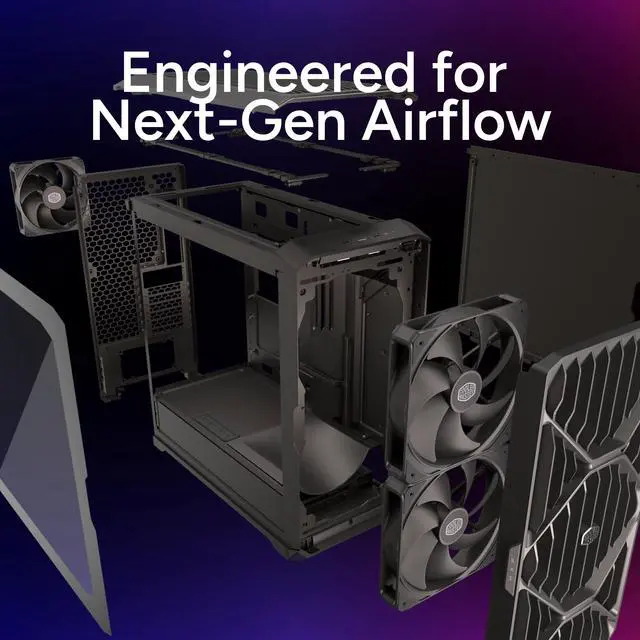
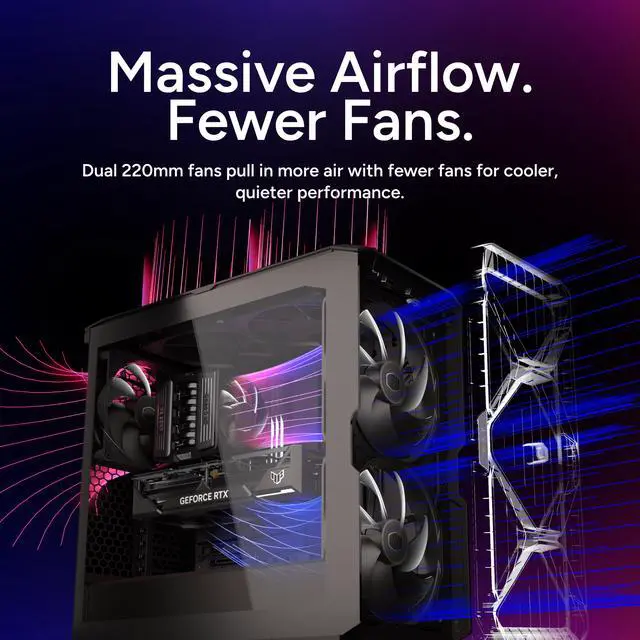
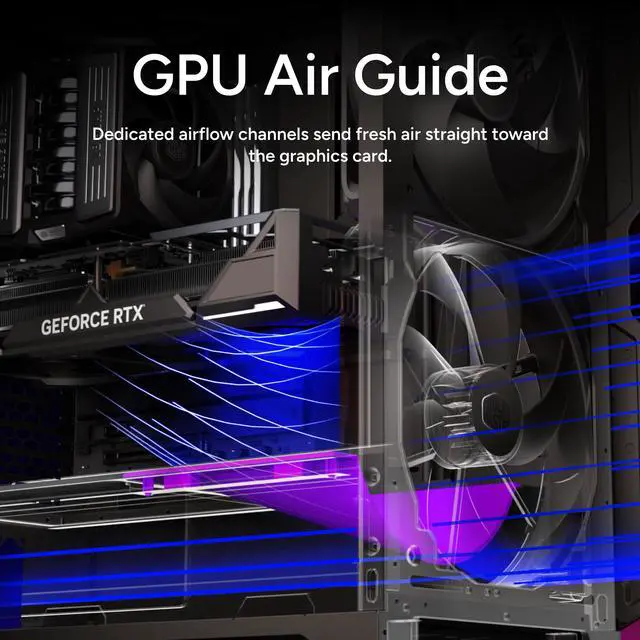


The Cooler Master HAF II 500 is a full-size ATX PC case built for high-airflow gaming and AI workstation systems, with two 220mm front fans, a 180mm rear fan, support for GPUs up to 430mm, and room for 360mm liquid cooling. It suits builders using large graphics cards, multi-GPU layouts, and oversized air or liquid cooling.
| Attribute | Value |
|---|---|
| Best For | High-airflow ATX mid-tower case for desktop builds that need support for large GPUs (up to 430 mm), multi-GPU/AI workstation configurations, and up to 360 mm AIO cooling |
| Case Type & Size | Mid-tower / Large ATX case; dimensions 557 x 262 x 548 mm (21.93 x 10.32 x 21.57 in); weight 14.2 kg |
| Materials & Panels | Chassis made from SGCC steel with ABS panels; left side tempered glass, right side SGCC |
| Motherboard Compatibility | Supports Mini-ITX, Mini-DTX, Micro-ATX, ATX, CEB (ATX-compatible standoff pattern) and E-ATX using ATX-compatible standoff pattern up to 310 mm wide |
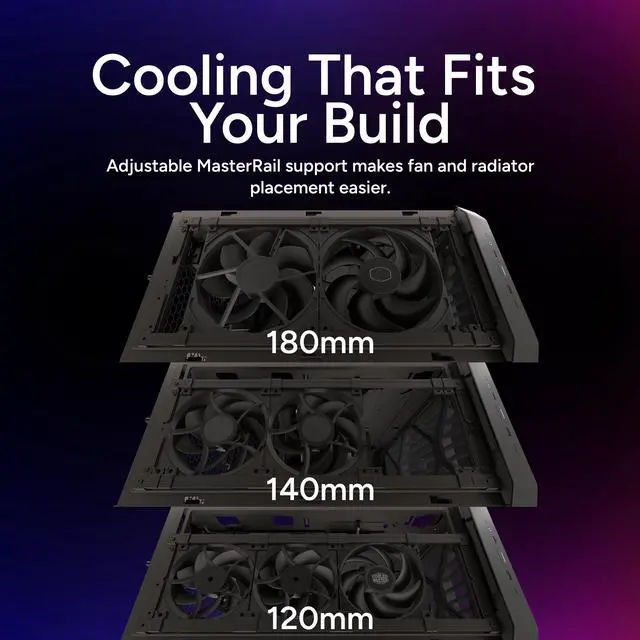
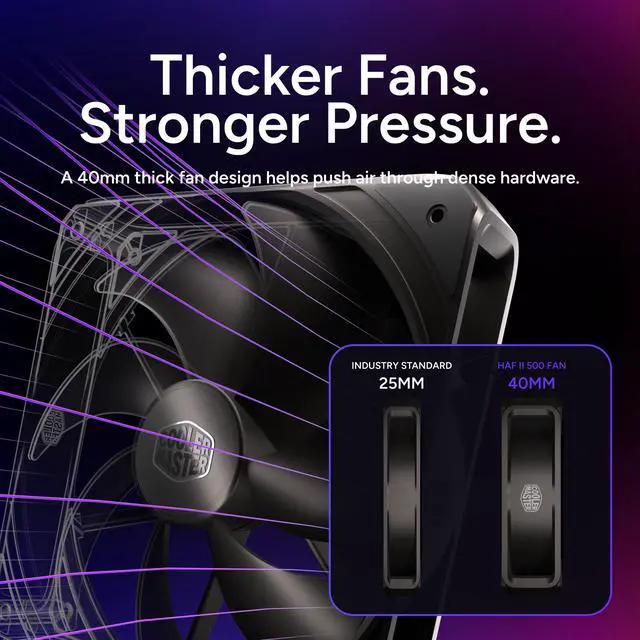
| Cooling & Fans | Air cooling with 3 preinstalled Mighty40 fans — 2 x Mighty40 F220 (220 x 40 mm) front intake and 1 x Mighty40 V180 (180 x 40 mm) rear exhaust; front and top accept multiple fan sizes via MasterRails (front default 2 x 220 mm or up to 3 x 120/140 mm or 2 x 160/180 mm; top up to 3 x 120/140 mm or 2 x 160/180 mm); rear 1 x 180 mm |
| Radiator & AIO Support | Supports AIO radiators up to 360 mm (front with MasterRails and top: 240 / 280 / 360-120 / 360-180 mm conditional support); rear supports 180 mm |
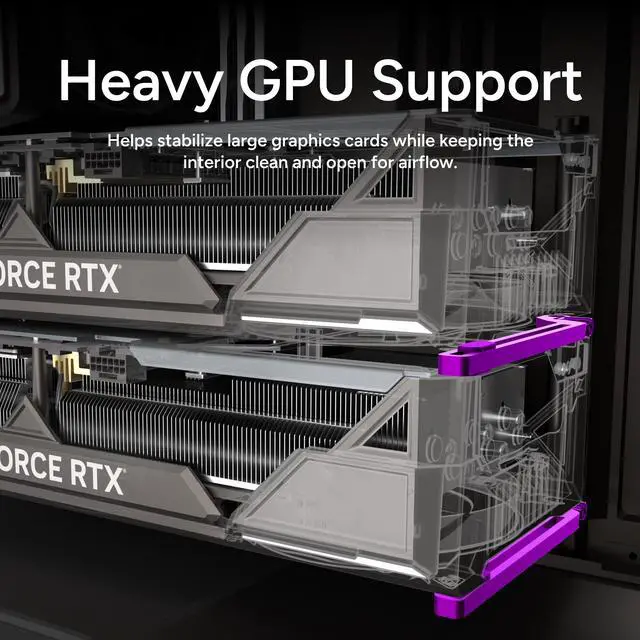
| GPU & Expansion Support | 8 expansion slots; supports up to four dual-slot GPUs; single-GPU max length 430 mm with front Mighty40 fans installed; GPU card thickness allowances: 72 mm per card when installing two, 40 mm per card when installing four |
| Drive Bays & Storage | Internal drive bay counts listed as 3/6 for 3.5" bays and 2/4 for 2.5" bays; accepts 2.5" drive form factor |
| Power Supply & Clearance | PSU clearance: 150 mm with north-south drive orientation or 210 mm with east-west drive orientation |
| CPU Cooler Clearance | Supports CPU coolers up to 221 mm (Intel) and 220 mm (AMD) |
| Front I/O & Controls | Front I/O includes 1 x USB 3.2 Gen 2x2 Type-C and 2 x USB 3.2 Gen 1 Type-A (3 total USB ports), 1 x 3.5 mm headset jack (audio + mic), power LED and reset switch |
| Dust Filters & Ventilation | Removable dust filters located at bottom, front, and top |
| MasterRails, Fan Hub & Other Features | MasterRails mounting system for flexible fan and radiator placement; includes 6-port PWM and 6-port ARGB fan hub and a dedicated GPU airflow design |
| Model Identifiers | Cooler Master H500G2-KGNN-S00 (Model Name: HAF II 500 / Model Number: H500G2-KGNN-S00); color: Black; manufacturer: Cooler Master; package quantity: 1 |
| Packaging | Package weight 18.824 kg; package dimensions 35.56 x 67.31 x 69.85 cm |
Q: Should I buy the Cooler Master HAF II 500 or the Lian Li Lancool 216 for an airflow-focused gaming build?
A: Choose the HAF II 500 if you want a larger, more premium airflow case with extra room for oversized GPUs, very tall air coolers, E-ATX support, and broader multi-radiator flexibility. Cooler Master positions it around balanced intake and exhaust with oversized 220 mm front fans and a 180 mm rear fan, and Tom’s Hardware found it delivered strong noise-normalized thermals with relatively quiet operation. Choose the Lancool 216 if you want a lower-cost airflow case that is widely recommended for strong GPU cooling and straightforward value. Professional testing on the Lancool 216 highlights its PCIe fan bracket as a meaningful advantage for GPU thermals, so it is often the better fit for mainstream single-GPU gaming builds where budget matters more than maximum interior volume.
Q: Is the HAF II 500 worth buying over the older Cooler Master HAF 500?
A: The HAF II 500 makes more sense if you want Cooler Master’s newer airflow concept rather than the older HAF 500 layout. Compared with the HAF 500, the HAF II 500 is positioned as a quieter, more balanced high-airflow design with larger 220 mm intake fans, a 180 mm rear exhaust, more internal width, much higher CPU cooler clearance, support for four dual-slot GPUs, and larger official GPU support. The older HAF 500 still remains a practical choice if you want the familiar mid-tower format and features like the dedicated GPU fan bracket at a lower historical price tier, but the HAF II 500 is the clearer upgrade for oversized modern hardware, dual-GPU or workstation-style builds, and low-RPM airflow tuning.
Q: Should I get the HAF II 500 or the Corsair 5000D Airflow for a high-end build?
A: Pick the HAF II 500 if your priority is maximum stock airflow from oversized fans, support for very large air coolers, and extra room for thick multi-GPU or workstation-style configurations. Pick the Corsair 5000D Airflow if your priority is a more conventional enthusiast layout with mature ecosystem support and a side-radiator option that many builders use for AIO-heavy configurations. In practical terms, the HAF II 500 is the more specialized choice for big-air cooling and physically larger components, while the 5000D Airflow is the more conventional choice for builders planning around multiple 120 mm fan positions and side-mounted radiator layouts.
Q: Is the HAF II 500 a better fit than the Fractal Torrent for air cooling?
A: Choose the HAF II 500 if you want a case that combines very strong stock airflow with broader compatibility for liquid cooling, extra-tall tower coolers, and unusual GPU configurations. Choose the Fractal Torrent if your goal is a pure air-cooling-first platform and you are comfortable building around a case that is widely recognized in reviews for top-tier GPU and overall thermal performance. The HAF II 500 is the more flexible all-around chassis for mixed cooling strategies, while the Torrent remains the stronger reference point when buyers specifically ask for an air-cooling-centric case and are willing to prioritize that over broader layout flexibility.
Q: Is the Cooler Master HAF II 500 a good choice for high-airflow gaming or AI workstation builds?
A: Yes, if your priority is moving a lot of air through powerful components. The HAF II 500 is better suited to hot-running gaming or workstation builds than many standard mid-towers because it includes two 220 mm front intake fans and one 180 mm rear exhaust fan, plus large front and rear ventilation. It is less ideal if you want a smaller, lighter, or quieter-focused case.
Q: Will it fit large modern GPUs and oversized air coolers?
A: Yes. This case is designed for unusually large hardware. It supports graphics cards up to 430 mm long, CPU coolers up to 221 mm tall on Intel platforms and 220 mm on AMD, and even allows two GPUs up to 72 mm thick each with the included dual-mode GPU holder. That makes it a safer choice than many mainstream airflow cases for extra-long GPUs or very tall tower coolers.
Q: Is it a better buy than a typical airflow mid-tower like the Corsair 4000D Airflow if I plan to use a 360 mm AIO and a big GPU?
A: Usually yes, if clearance and cooling headroom matter more than compact size. The HAF II 500 supports 360 mm radiators at the top and front, comes with much larger stock fans, and offers 430 mm GPU clearance. A typical airflow mid-tower like the 4000D Airflow also supports a 360 mm radiator, but its GPU clearance is lower at 360 mm and it ships with smaller included fans. The trade-off is that the HAF II 500 is much larger and heavier.
Q: Who is this case best suited for?
A: It is best for builders who want maximum airflow, broad hardware compatibility, and room for future upgrades. That includes high-end gaming PCs, AI or creator workstations, multi-GPU setups with space limits in mind, and users who prefer large air coolers or 360 mm liquid cooling. It is less suitable for compact desks, portable builds, or buyers who only need a basic mainstream ATX case.
Q: What are the main trade-offs of choosing the HAF II 500?
A: The main trade-off is size for capability. You get stronger stock airflow, support for very large GPUs, support for 360 mm radiators, and flexible motherboard compatibility up to wide E-ATX patterns. In return, the case is physically large at 557 x 262 x 548 mm and weighs 14.2 kg, so it is less convenient for tight spaces or users who move their system often.
Q: Who is the Cooler Master HAF II 500 best suited for?
A: The HAF II 500 is best suited for builders who prioritize airflow, oversized air coolers, and very large GPUs over compact size or understated styling. Based on the product specs, it fits up to 430 mm graphics cards, supports 360 mm radiators, includes two 220 mm front fans plus a 180 mm rear fan, and allows unusually tall CPU coolers. Reddit discussion around recent reviews repeatedly frames it as an airflow-first case that competes with cases like the Fractal Torrent and Lancool 217, rather than as a style-focused or space-saving option.
Q: Is the HAF II 500 a good choice for high-end air-cooled or multi-GPU builds?
A: Yes, if your priority is physical clearance and direct airflow. The case supports very large GPUs, very tall tower coolers, and includes a GPU holder that can stabilize one card or support two thick GPUs. It also has airflow-focused fan placement and large vent openings. For workstation or AI-style builds with large components, those layout and cooling features make it a practical choice. The trade-off is size: this is a large, heavy case, not a compact ATX tower.
Q: What are the main trade-offs of buying the HAF II 500?
A: The main trade-offs are size, weight, appearance, and likely value sensitivity at the premium end. Community discussion around recent review posts repeatedly praises the airflow concept but raises concerns about styling and fit-and-finish for a roughly $200-class case. Buyers who care most about cooling and hardware room may accept those compromises, but buyers focused on refined exterior design or premium construction may want to compare alternatives first.
Q: Is the HAF II 500 worth considering over the Fractal Torrent?
A: It is worth considering if you want a newer airflow-focused case with modern front I/O, broad radiator support, and explicit support for very large GPUs. Reddit comparison threads place it in the same decision set as the Fractal Torrent, mainly for buyers choosing between top-tier airflow cases. The HAF II 500 looks stronger on flexibility for radiator and GPU configurations, while the Torrent is more established and may appeal more to buyers who prioritize a proven design and different aesthetics.