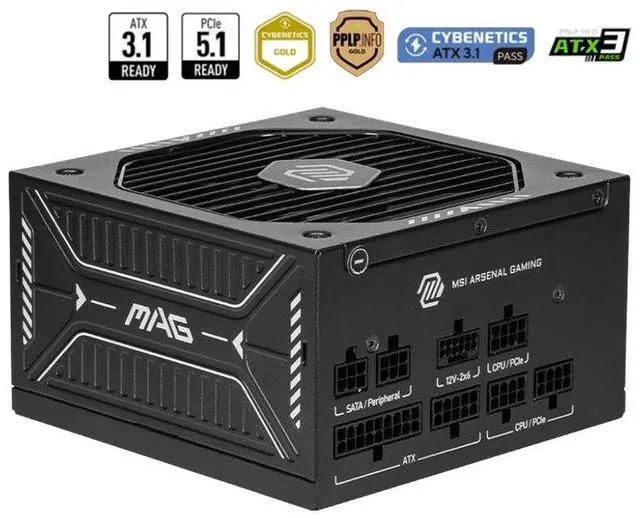
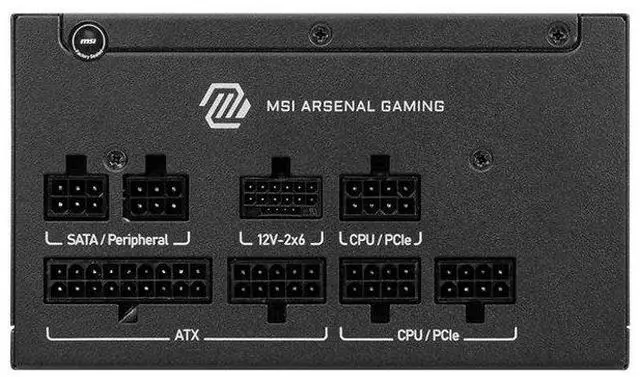
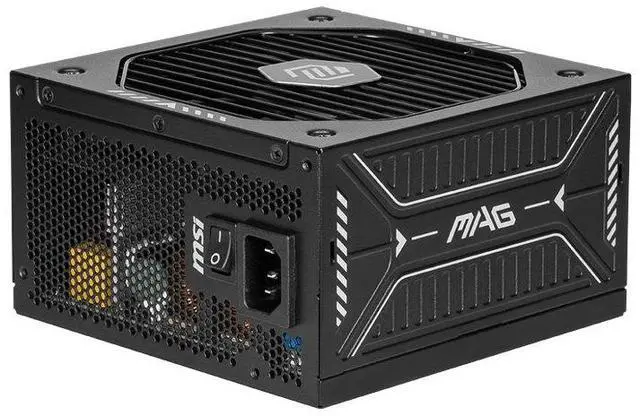
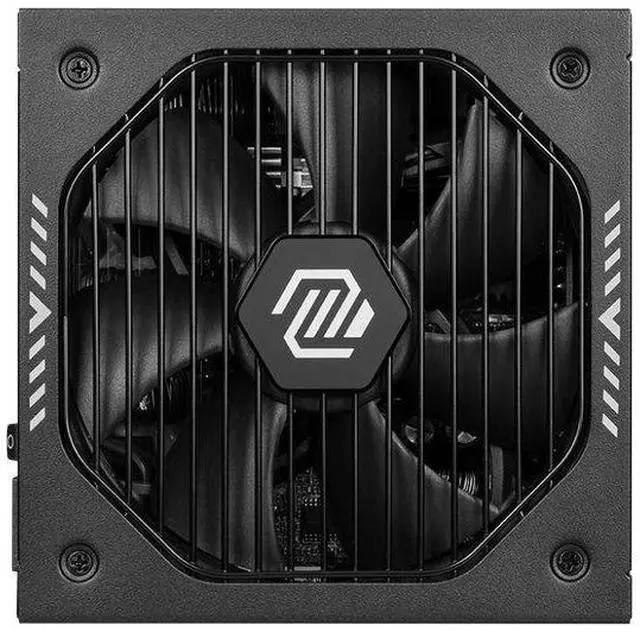
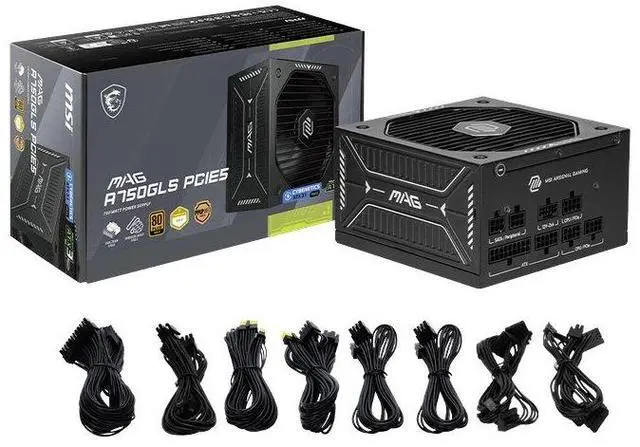
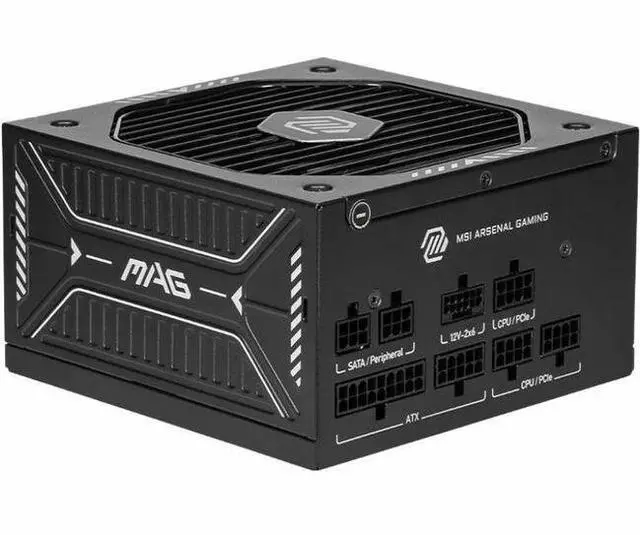
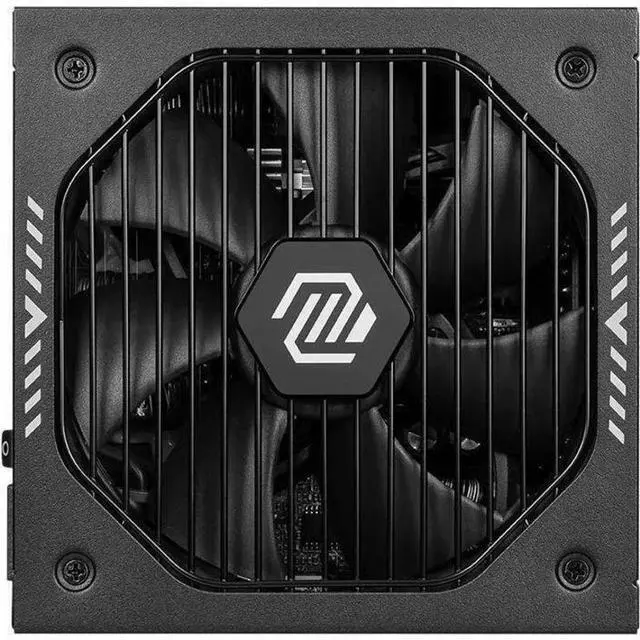
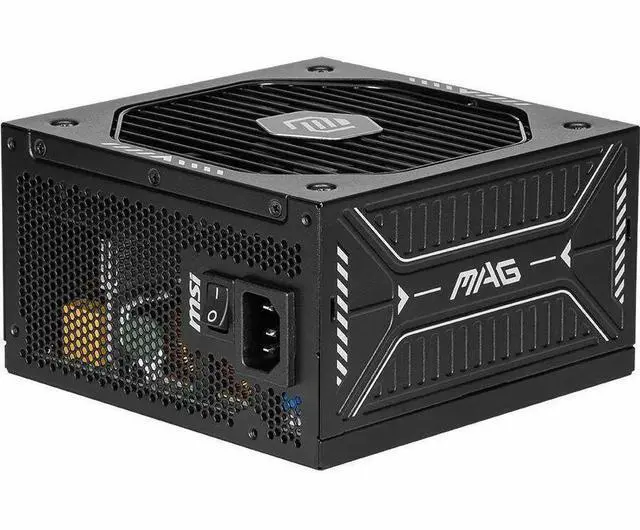
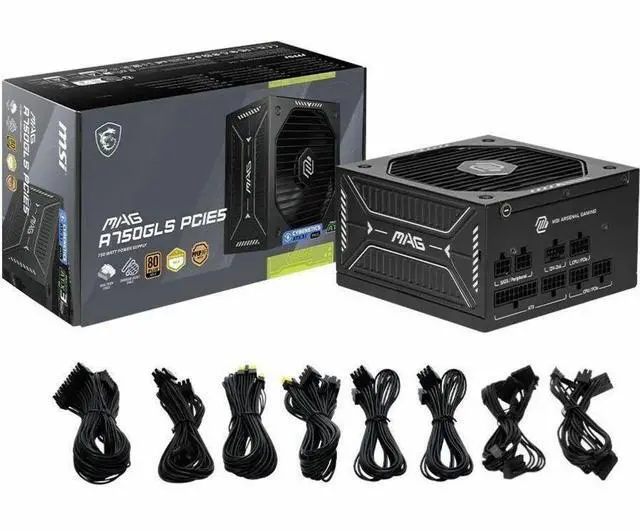
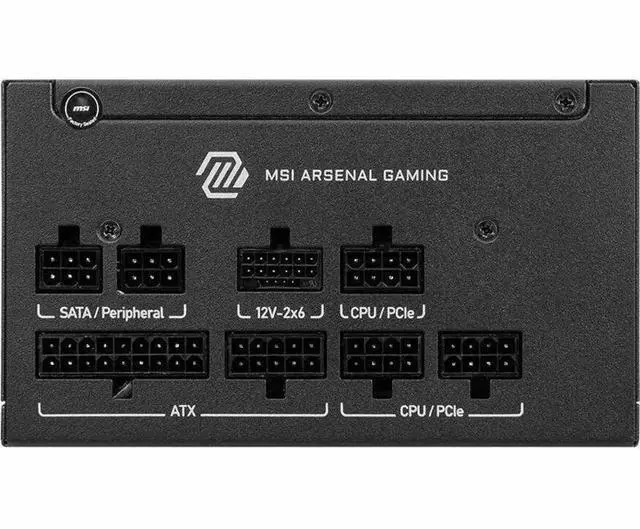
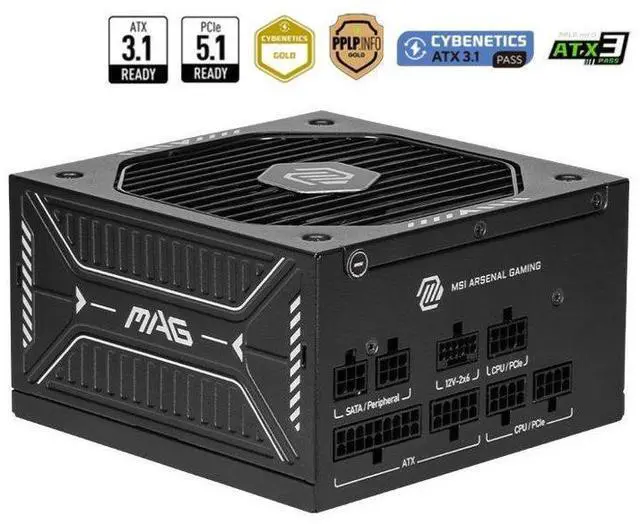
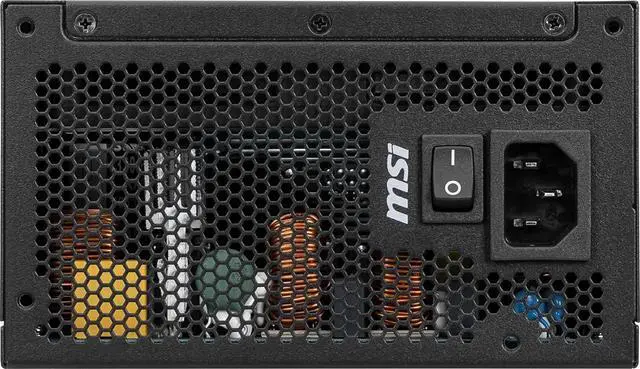
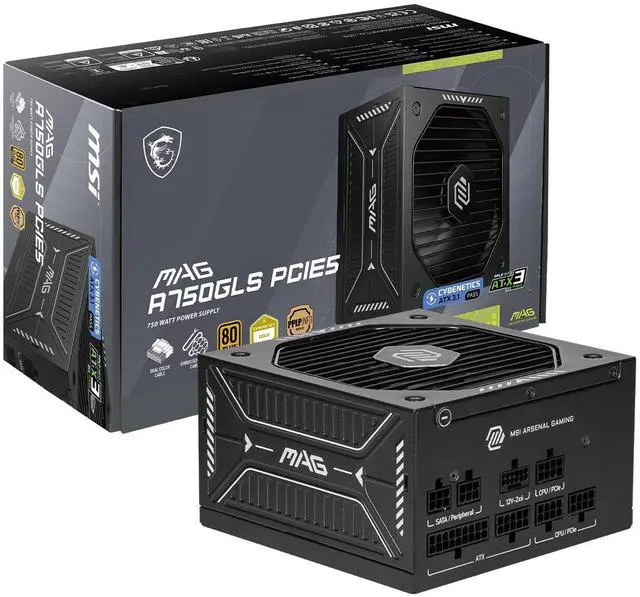
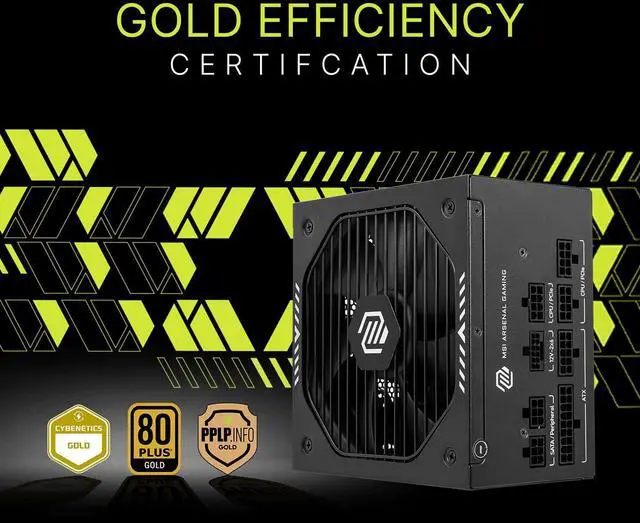
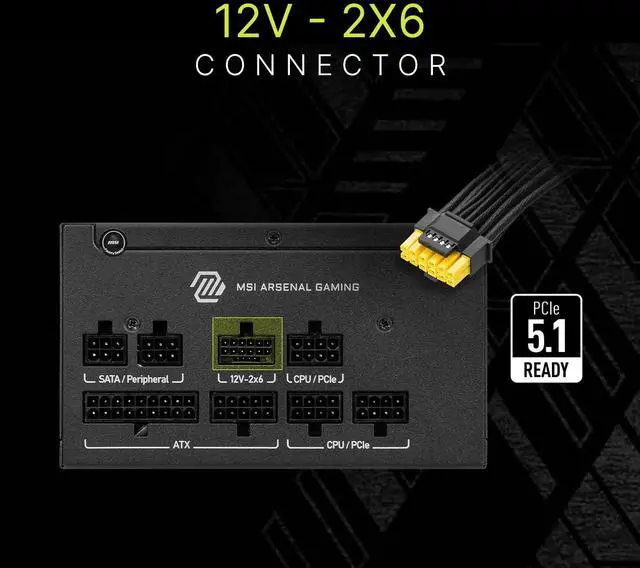
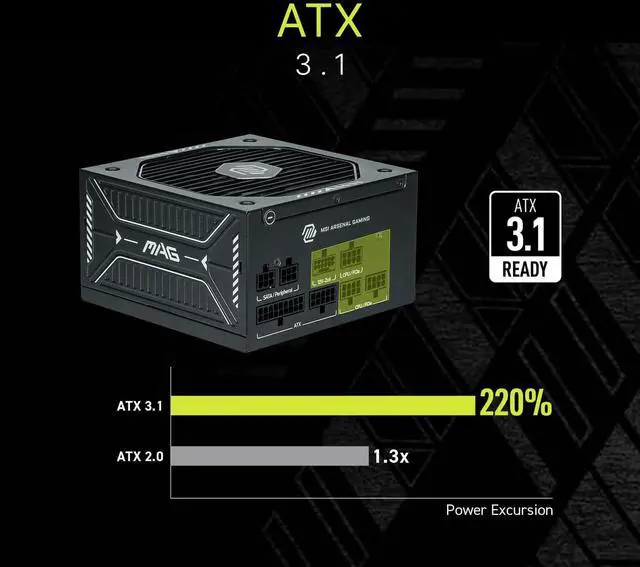
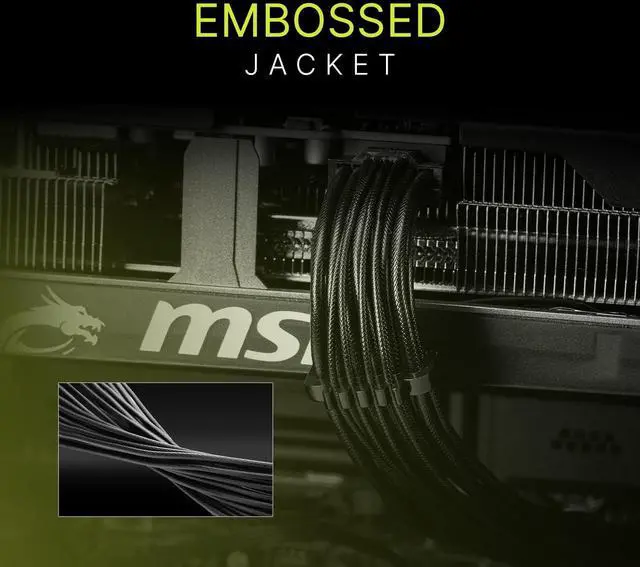
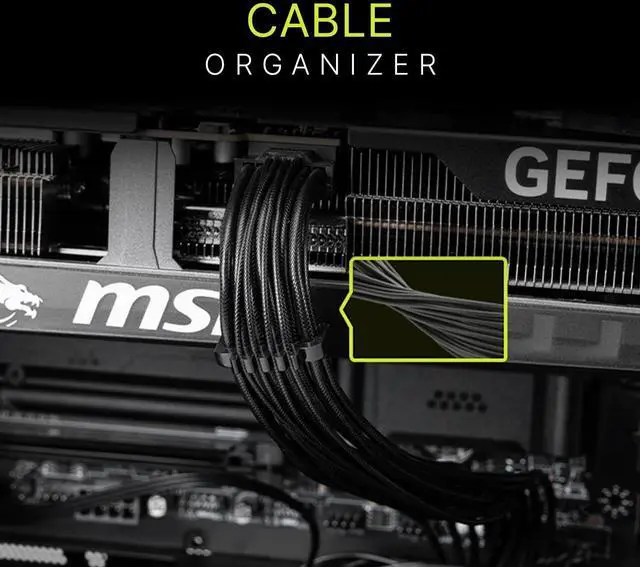
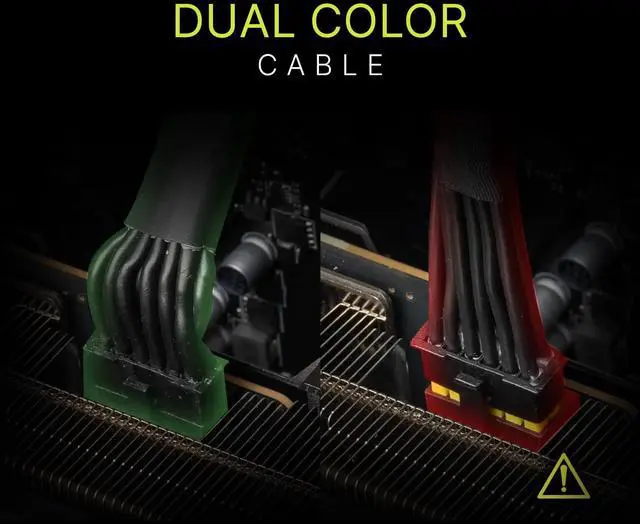
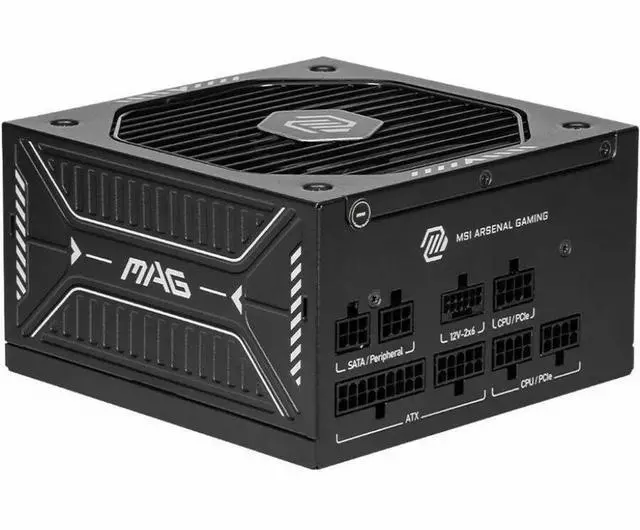
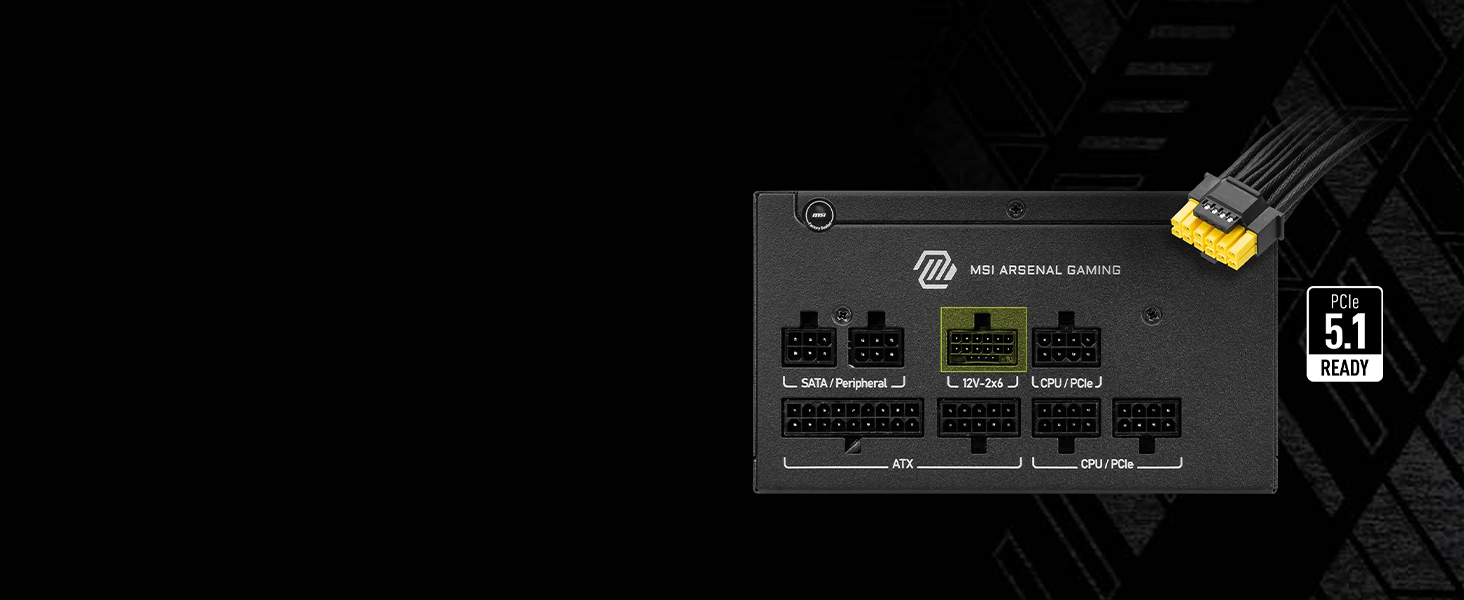
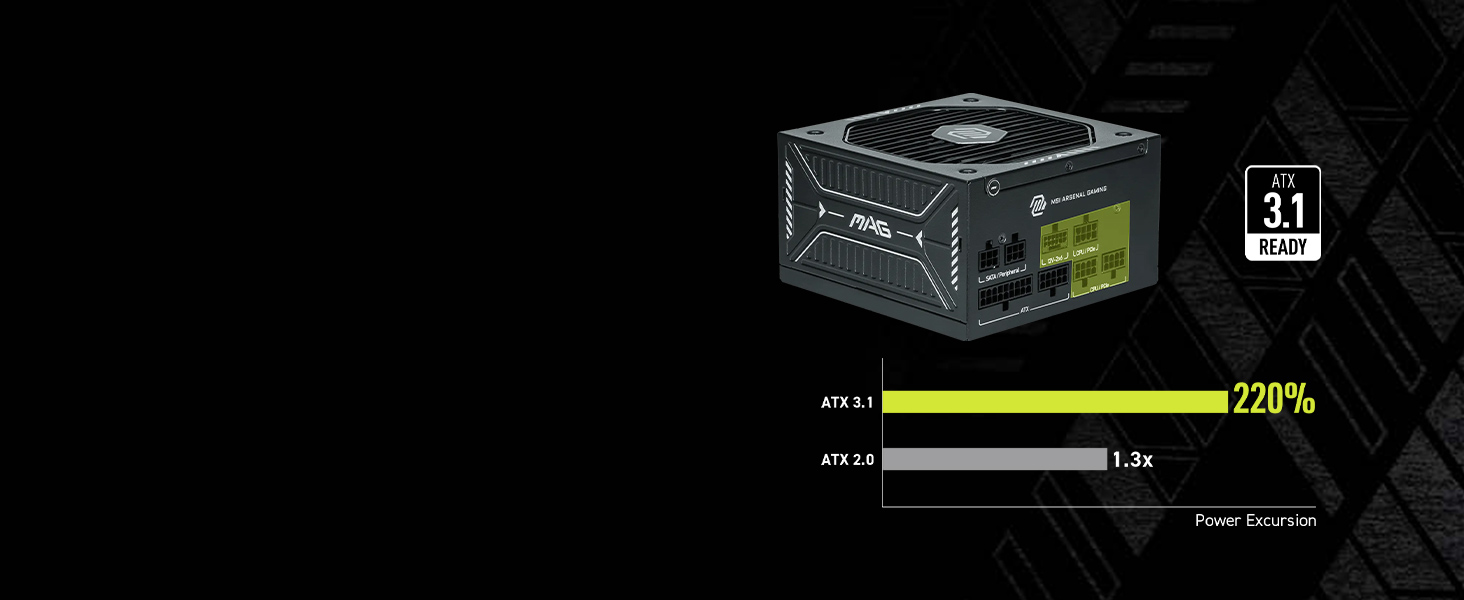
The MSI MAG A750GLS PCIE5 is a fully modular 750W ATX gaming power supply for performance-focused PCs using modern PCIe 5.1 graphics cards. Its 80 PLUS Gold efficiency, native 12V-2x6 connector, ATX 3.1 readiness, low-noise 135 mm FDB fan, and 10-year warranty suit demanding gaming and upgrade-ready builds.
Recommended For
- PC builders assembling a mainstream gaming system with a single midrange-to-upper-midrange GPU, such as an RTX 4070-, RTX 5070-, or similar-class card, who want 750W of upgrade headroom without moving to a larger PSU.
- Builders using newer NVIDIA RTX 40- or RTX 50-series graphics cards who prefer a native 12V-2x6 cable and ATX 3.1/PCIe 5.1 support instead of relying on older adapter cables.
- PC builders working in cases with limited PSU clearance who need a fully modular ATX power supply measuring 150 mm deep, leaving more room for cable routing and front-to-back airflow.
- Gamers and streamers who want a moderately quiet PSU for typical desktop gaming loads, while accepting that fan noise can increase during sustained high-power workloads.
- First-time or budget-conscious PC builders who want simpler cable management from a fully modular PSU and prefer a current-generation platform over an older ATX 2.x model.
Real-World Use Scenarios
- Building a current single-GPU gaming PC with an RTX 50-series card: the native 12V-2x6 cable lets the user connect a compatible graphics card directly, while the ATX 3.1 design provides support for short-duration GPU power spikes without relying on multiple adapter cables.
- Upgrading an older gaming PC to a newer graphics card: the 750W capacity gives a typical mainstream or upper-midrange single-GPU system operating headroom, provided the complete system's estimated power draw remains within the PSU's limit.
- Assembling a compact ATX gaming or workstation PC: the 150 mm depth and fully modular cabling make it easier to install the power supply, remove unused cables, and preserve room for airflow and cable routing in cases with limited clearance.
- Playing games or running GPU-heavy workloads in a room where fan noise matters: the semi-passive fan mode and relaxed fan profile can keep the PSU unobtrusive at light-to-moderate loads, while independent testing measured roughly 24 dBA average noise under its test conditions.
- Building a gaming, streaming, or AI-focused desktop with several drives and accessories: the modular design and multiple SATA, PCIe, and EPS connections allow the user to connect a multi-drive setup and a high-power graphics card without installing every cable included in the box.
Reference Q&A
Q: Is the MSI MAG A750GLS PCIE5 better than the MSI MAG A750GL PCIE5?
A: Choose the MAG A750GLS PCIE5 when lower fan noise is a priority. Both models provide 750W, full modular cabling, 80 PLUS Gold efficiency, and modern PCIe support, but independent testing found the GLS model uses a more relaxed fan profile and operates noticeably quieter than the standard A750GL. Choose the A750GL when it is substantially less expensive and noise is less important.
Q: Should I buy the MSI MAG A750GLS PCIE5 or Corsair RM750e?
A: Choose the MSI MAG A750GLS PCIE5 if you want a 150 mm-long ATX power supply, a 135 mm fluid-dynamic-bearing fan, and a native 12V-2x6 connector rated for up to 450W. Choose the Corsair RM750e if your case benefits from its shorter 140 mm chassis or if you specifically want its 600W 12V-2x6 cable configuration. Both are 750W, fully modular, 80 PLUS Gold units with ATX 3.1-class support, so the better choice depends mainly on chassis clearance, GPU power requirements, and price.
Q: Is the MSI MAG A750GLS PCIE5 enough, or should I get the MAG A850GLS PCIE5?
A: The MAG A750GLS PCIE5 is suitable for a mainstream gaming PC using one graphics card and a total system load that remains comfortably below 750W. Choose the MAG A850GLS PCIE5 when you are pairing a higher-power GPU with a power-hungry CPU, want more upgrade headroom, or need its native 12V-2x6 output rated for up to 600W instead of the A750GLS's 450W rating. The 850W model keeps the same 150 mm ATX depth and 80 PLUS Gold positioning.
Q: Should I choose the MSI MAG A650GLS PCIE5 or the A750GLS PCIE5?
A: Choose the MAG A650GLS PCIE5 for a lower-power gaming build where a 650W capacity is sufficient and the graphics card does not require substantial transient-power headroom. Choose the MAG A750GLS PCIE5 for a higher-performance GPU, a power-hungry CPU, or a future upgrade because it provides 100W more rated capacity and a stronger 12V rail. Both models target compact, fully modular, 80 PLUS Gold ATX systems with PCIe 5.1 connectivity.
Q: Is 750W enough for a modern gaming PC?
A: It can be suitable for many mid-range and some high-performance gaming PCs, especially when the GPU manufacturer recommends 750W or less. Confirm the complete system requirement, including the CPU, GPU, storage, cooling, and planned upgrades, before buying. Systems with a higher-power GPU or substantial overclocking may need a higher-wattage PSU.
Q: Does this power supply work with newer graphics cards?
A: Yes. The MSI MAG A750GLS PCIE5 supports ATX 3.1 and PCIe 5.1 and includes a native 12V-2x6 connector rated to deliver up to 300W. It is designed for compatible modern graphics cards, but you should still verify the GPU manufacturer's recommended PSU wattage and connector requirements.
Q: Will this PSU fit in a compact ATX gaming case?
A: The unit uses a compact 150 mm by 150 mm ATX form factor, which should fit most standard ATX-compatible cases and leaves more room for cable management. Check the case's PSU-length clearance and cable-routing space before installation, especially in small-form-factor or nonstandard systems.
Q: Is this power supply quiet enough for gaming and everyday use?
A: It is designed for low-noise operation and has a Cybenetics A noise rating plus a 135 mm fluid-dynamic bearing fan. Noise will still vary with system load, ambient temperature, case airflow, and fan speed, so it should be considered low-noise rather than completely silent.
Q: Is a fully modular PSU useful for a new PC build?
A: Yes. The fully modular design lets you connect only the cables the build requires, which can reduce cable clutter and simplify routing in compact cases. It does not increase system performance, and only the cables supplied with this PSU should be used because modular PSU cables are not universally interchangeable.