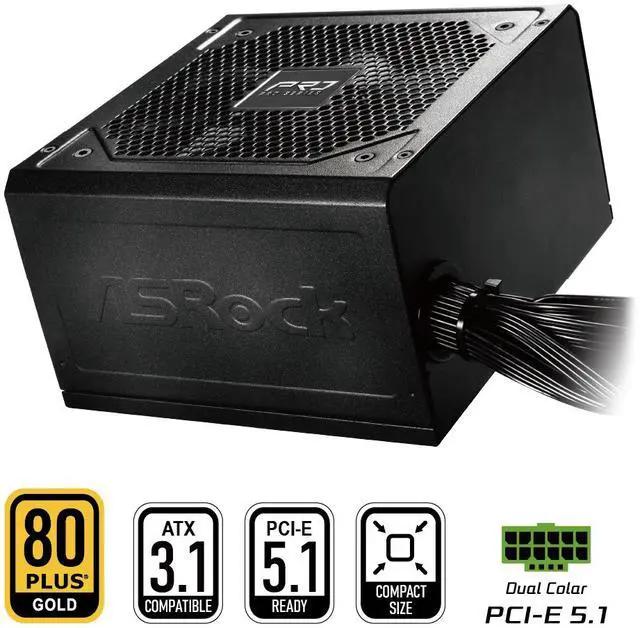
The ASRock PRO Series PRO-750G is a 750W ATX 3.1 power supply with 80 PLUS Gold efficiency and a native 12V-2x6 connector, making it a strong fit for mainstream gaming or creator PCs using modern GPUs and standard ATX cases.
Recommended For
- Builders putting together a value-focused gaming PC with a current midrange-to-upper-midrange GPU who want native 12V-2x6 support and ATX 3.1 compatibility without moving to a pricier PSU tier.
- PC upgraders replacing an older PSU for an RTX 40-series or similar newer card who want to avoid adapter-based GPU power cabling and keep the install straightforward.
- First-time or budget-conscious builders who care more about meeting modern PSU standards and staying in a commonly recommended value bracket than about premium extras like fully modular cabling.
- Mainstream desktop users building in standard ATX cases who want a short 140 mm PSU and enough headroom for a single-GPU system used for gaming, school, or everyday creation work.
Real-World Use Scenarios
- Building a mainstream gaming PC with one modern graphics card: the native 12V-2x6 cable and 750W capacity make it a practical fit for single-GPU builds, so most users can power current mid-range to upper-mid-range gaming systems without using a GPU adapter.
- Putting together a budget-conscious first PC build: community build advice frequently treats the PRO-750G as a low-cost step up from older bronze units, with enough headroom for common Ryzen or Core + midrange GPU combinations and fewer immediate upgrade concerns.
- Installing a PSU in a compact mid-tower case: the short 140mm housing is easier to fit than many longer ATX power supplies, so builders usually have an easier time with PSU shrouds, front-mounted drives, and cable clearance in tighter layouts.
- Replacing an older PSU during a GPU upgrade: this model is positioned for users moving to newer graphics cards that prefer a direct 12V-2x6 connection, so the experience is typically cleaner and simpler than reusing an older supply with bundled adapter cables.
- Running an everyday gaming or work-from-home desktop for long sessions: the expected real-world outcome is normal, stable operation rather than specialty tuning features, making it more suitable for standard daily use than for buyers specifically seeking premium acoustics or enthusiast monitoring extras.
Spec Summary
| Attribute | Value |
|---|
| Best For | ATX 3.1 desktop builds that need 750 W with 80 PLUS Gold efficiency and a PCIe5.1 12+4 connector; suited to systems that accept fixed (non-modular) cabling |
|---|
| Power And Efficiency | 750 W total output with 80 PLUS Gold efficiency |
|---|
| Connectors And Cables | Fixed (non-modular) cable set including 1×24‑pin ATX, 1×EPS 4+4, 1×PCIe5.1 12+4, 2×PCIe 6+2, 4×SATA and 2×4‑pin peripheral connectors |
|---|
| Cooling And Fans | Air-cooled with one 120 mm fan |
|---|
| Physical Dimensions And Weight | Chassis 140 x 150 x 86 mm (5.51 x 5.91 x 3.39 in); item weight 4.78 lb; PSU length 140 mm |
|---|
| Electrical Input | AC input 100–120 V (AC); 750 W output rating |
|---|
| Protection And Reliability | Integrated protections: OCP, SCP, OVP, UVP, OTP, OPP and MTBF greater than 100,000 hours |
|---|
| Compatibility And Form Factor | ATX 3.1 compatible, non-modular desktop power supply designed for personal computers |
|---|
| Model Identifiers | ASRock PRO Series — model PRO-750G (Model Number 90-UXR075-GNUAA2); style name 750G |
|---|
Reference Q&A
Q: Should I choose the ASRock PRO-750G or move up to an 850W ATX 3.1 PSU?
A: Choose the ASRock PRO-750G if your build is centered on a mainstream to upper-midrange GPU and you want native 12V-2x6 support in a compact 140 mm PSU. Move to an 850W model if you expect a higher-power GPU, heavier transient loads, or want more upgrade headroom for future platform changes. In real-world builder discussions, 750W is commonly treated as enough for many RTX 4070 Super and 4070 Ti Super class systems, while 850W is the more flexible pick when users want extra margin.
Q: Is the ASRock PRO-750G a better fit than a 650W PSU for a new gaming PC?
A: The ASRock PRO-750G is the better fit if you want more room for GPU upgrades and a native 12V-2x6 cable instead of sizing only for today's parts list. A 650W unit can still be appropriate for efficient midrange builds, but 750W is the more common recommendation when buyers want to avoid replacing the PSU at the next graphics upgrade. The trade-off is simply capacity and flexibility rather than a major change in day-to-day behavior.
Q: ASRock PRO-750G vs Corsair RM750e: which one makes more sense?
A: Pick the ASRock PRO-750G if you mainly want a straightforward ATX 3.1, PCIe 5.1-ready 750W unit with a native 12V-2x6 connector and compact 140 mm depth. Pick the Corsair RM750e if long warranty coverage and broader review coverage matter more to you, since Corsair positions the RM750e as an ATX 3.1, PCIe 5.1 fully modular model and it is much more widely tested by review outlets. The practical trade-off is newer ASRock entry positioning versus Corsair's longer-established review and warranty profile.
Q: ASRock PRO-750G vs MSI MAG A750GL: what is the practical difference?
A: These two PSUs target a very similar buyer: someone who wants 750W, ATX 3.1-era compatibility, and a native PCIe 5.x GPU cable. The ASRock PRO-750G makes sense if you are comparing on basic fit, compact dimensions, and official support for the dual-color 12V-2x6 connector. The MSI MAG A750GL makes more sense if you prefer a model with more third-party test coverage, including review and lab-style video testing. This comparison is usually less about wattage and more about how much independent validation you want before buying.
Q: Should I buy the ASRock PRO-750G for a compact build, or choose a larger premium PSU instead?
A: Buy the ASRock PRO-750G if your case benefits from a shorter 140 mm PSU and you still want current-gen ATX 3.1 and PCIe 5.1 cable support. Choose a larger premium PSU if your priority is stronger third-party validation, longer warranty coverage, or a higher-end internal platform rather than space efficiency. For small or tighter mid-tower layouts, the shorter chassis is a practical advantage because it can leave more room for cable management without giving up native 12V-2x6 support.
Q: Is the ASRock PRO-750G a good fit for a mid-range to upper-mid-range gaming PC?
A: Yes. A 750W Gold PSU is a practical fit for many gaming builds that use a modern mainstream CPU and a single performance GPU. The ASRock PRO-750G is especially relevant for newer builds because it supports ATX 3.1 and includes a native 12V-2x6 connector rated for 450W, which aligns with the kind of compatibility questions shoppers repeatedly ask about newer GPU-ready power supplies. It is less ideal if you are planning a very high-end GPU or heavy future upgrades that may justify 850W or more.
Q: Will this power supply work with newer PCIe 5.x graphics cards?
A: Yes, for many newer GPUs it should be a straightforward match. The PRO-750G is ATX 3.1 compatible and includes a native PCIe 5.1 12V-2x6 connector, which is one of the most common compatibility concerns on retail PSU Q&A pages. The main limitation is not connector type but total system power demand: if your GPU and CPU combination pushes well beyond what a quality 750W unit is comfortable with, a higher-wattage model is the safer choice.
Q: Who is the ASRock PRO-750G best suited for?
A: It is best suited for buyers building a standard ATX desktop who want modern GPU connector support, solid efficiency, and a compact PSU length without paying for a more premium long-warranty model. It makes the most sense for mainstream gaming, general productivity, and balanced creator builds. It is a weaker fit for buyers who prioritize premium features such as longer warranty coverage, more cables, or more upgrade headroom.
Q: What are the main trade-offs versus a more premium 750W competitor PSU?
A: The main trade-off is value versus longevity and extras. On paper, the ASRock PRO-750G covers the core buying needs well: 750W capacity, 80 Plus Gold efficiency, ATX 3.1 support, PCIe 5.1 readiness, and standard protection features. The clearest compromise is its 3-year warranty, which is much shorter than the 7- to 10-year coverage commonly seen on more premium competing 750W Gold units. Buyers focused on long-term ownership or multiple upgrade cycles may prefer a higher-tier alternative.
Q: Should you buy this instead of an 850W model?
A: Choose the PRO-750G if your build is already well matched to 750W and you want a current-generation connector set without overspending on unused wattage. Choose 850W instead if you expect a more power-hungry future GPU, frequent upgrades, or simply want more headroom. Retail Q&A patterns around 750W PSUs often center on whether they are 'enough' for a specific GPU, and that is the right decision test here too: buy for your real power budget, not just connector compatibility.
Q: Is the ASRock PRO-750G a good budget 750W PSU for a modern gaming PC?
A: Yes, if your priority is low cost with current platform support. Reddit discussions repeatedly frame the PRO-750G as a value-focused 750W option because it combines 80 Plus Gold efficiency, ATX 3.1 support, and a native 12V-2x6 connector. The main compromise is that it is a basic non-modular design with a shorter 3-year warranty than many higher-end PSUs.
Q: Who is the ASRock PRO-750G best suited for?
A: It is best suited for mainstream builders who want a 750W PSU for a mid-range to upper-mid-range gaming system and want native support for newer GPUs without using an adapter. It fits buyers who care more about price and core compatibility than premium features such as modular cabling or a long warranty.
Q: What are the main trade-offs of choosing the ASRock PRO-750G over a pricier PSU?
A: The main trade-offs are features and long-term coverage, not basic wattage or connector support. Compared with more expensive PSUs, the PRO-750G is positioned as a simpler unit: non-modular cabling, a 140 mm standard form factor, one native 12V-2x6 cable rated for 450W, and a 3-year warranty. Buyers choosing it are usually trading convenience and longer warranty coverage for lower upfront cost.
Q: Is the ASRock PRO-750G a sensible pick if I am upgrading to a newer GPU?
A: Yes, it is a sensible pick if your system fits within 750W and you want direct support for newer graphics cards. Community discussion around the PRO-750G often focuses on its ATX 3.x-era positioning and native 12V-2x6 connector, which makes it more relevant for modern GPU upgrades than older budget PSUs that rely on adapters or older connector layouts.