



Casio Pathfinder Solar Powered Multi-Function Sport Watch With Triple Sensor, Black, PAG-240-1CR
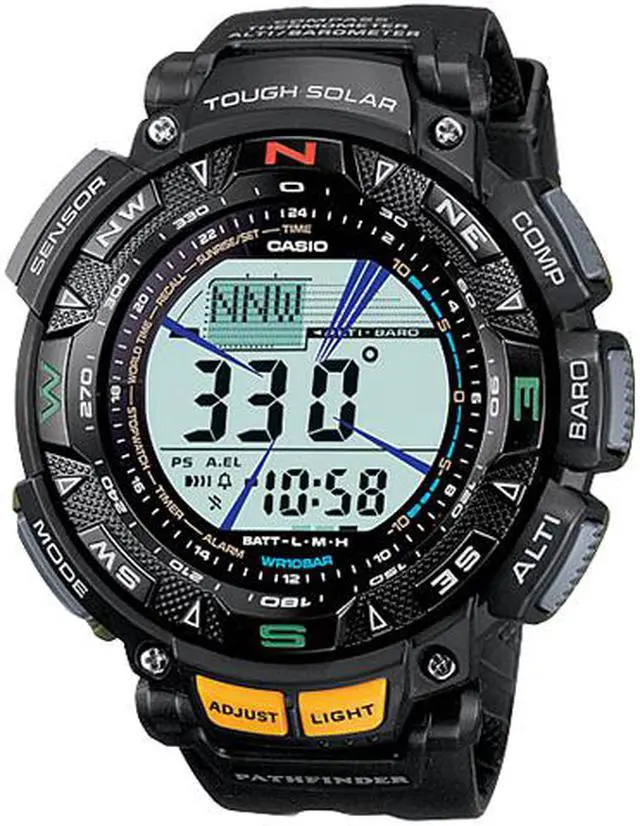
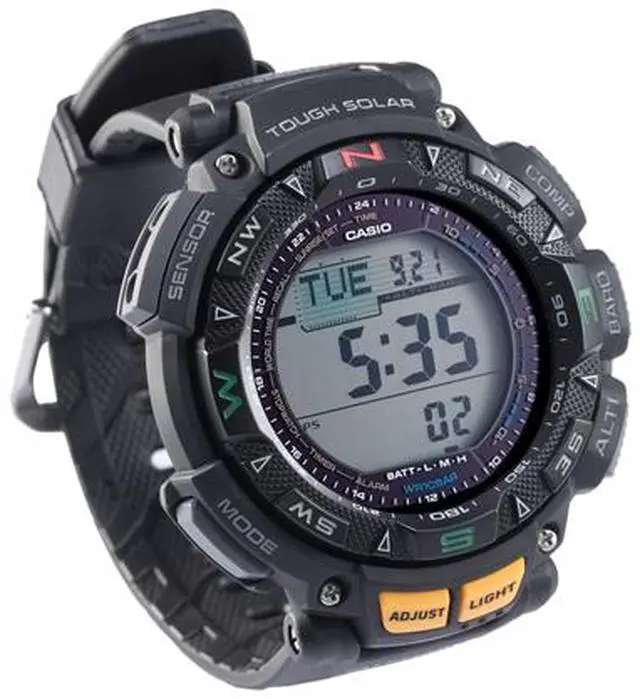
Constantly evolving and improving the PRO TREK lineup, Casio introduces the PAG240T-7, a welcome upgrade to the legendary PAG40.
FEATURES

The altimeter determines the altitude at your current location based on accumulated atmospheric pressure changes measured by the pressure sensor. Setting the altimeter at a location where you know the precise altitude before starting you ascent enables it to take even more precise altitude measurements.

The barometer measures the atmospheric pressure every two hours automatically and displays the recent atmospheric pressure tendency and the current pressure graphically. Level when you take subsequent measurements after moving on.

The Bearing Memory memorizes directions detected by the direction measurements function and displays them continuously in graphic format. You can travel straight toward your destination by following a course determined with the memorized direction displayed steadily in the 12 o'clock position on your watch face. This capability also comes in handy when visibility is low due to such factors as trees or fog.

The Sunrise, Sunset time display is a convenient tool for planning climbs.

The dual-layer LCD displays data of various kinds, enabling graphic display of the results compiled by multiple functions.

This solar-powered battery-recharging system ensures stable operation even when using power-hungry functions.

A large register ring employing a rotating mechanism to store direction memories is installed around the face. Its uneven surface design is ideal for rotating the ring with a finger.

The light senses illumination levels and switches on automatically with just a tilt of the wrist.
specifications
| Brand, Seller, or Collection Name | Casio |
| Model number | PAG240-1CR |
| Part Number | PAG240-1CR |
| Model Year | 2011 |
| Item Shape | Round |
| Dial window material type? 1 | Mineral |
| Display Type | Digital |
| Clasp | Buckle |
| Metal stamp | None |
| Case material | Stainless steel |
| Case diameter | 5.1 centimeters |
| Case Thickness | 15 millimeters |
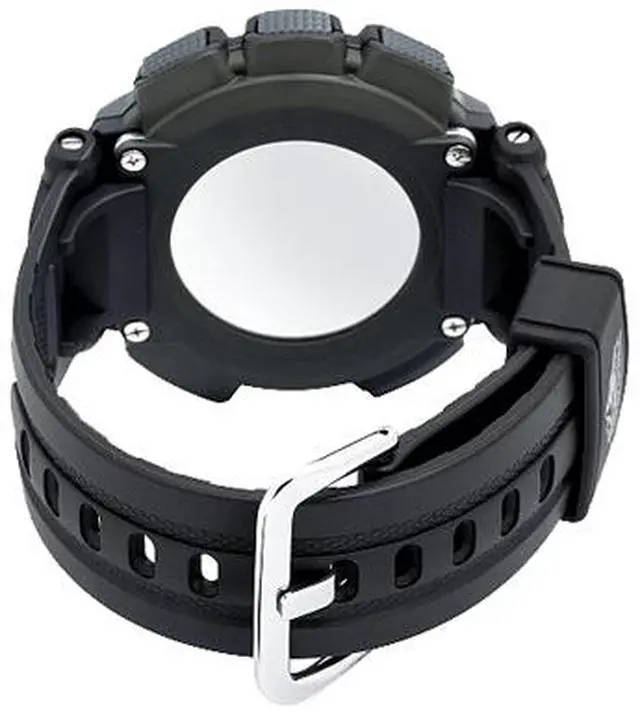
| Band Material | Resin |
| Band length | Men's Standard |
| Band width | 18 millimeters |
| Band Color | Black |
| Dial color | Grey |
| Bezel material | Resin |
| Bezel function? 2 | Bidirectional |
| Calendar? 3 | Day, date, month, and year |
| Special features | alarm-feature, altimeter-feature, Compass, Stop watch, Water Resistant |
| Movement?4 | Quartz |
| Water resistant depth | 330 Feet |
1 The covering of the watch dial. Acrylic, mineral, and sapphire are the three types of crystals commonly used in watches. Acrylic crystal is an inexpensive plastic that allows shallow scratches to be buffed out. Mineral crystal is composed of several elements that are heat-treated to create an unusual hardness that helps resist scratches. Sapphire is the most expensive and durable crystal, approximately three times harder than mineral crystals and 20 times harder than acrylic crystals.
2 Bidirectional: A bezel that rotates both clockwise and counterclockwise. It may have printed or engraved markers, numbers, or directional markers.
Interchangable: A bezel that can be removed and replaced by another bezel. In most cases, a watch with an interchangeable bezel comes as a set.
Slide-Rule: A rotating bezel that is printed or engraved with a logarithmic scale, metric scale, or other scales. It is used with fixed mathematical rules, allowing the wearer to perform directional/navigational or mathematical calculations.
Stationary: A bezel that does not rotate.
Tachymeter (or Tachometer): A bezel that allows the wearer to calculate speed based on travel time over a fixed distance traveled. For this reason, most tachymeter bezels will have markings or scales printed or engraved on the surface.
Unidirectional: A bezel that rotates one way. Most unidirectional bezels rotate counterclockwise. In many dive watches, it is used to measure elapsed time spent underwater.
3 Date: The watch displays the date of the month.
Date and Moon Phase: The watch displays the date of the month and the phase of the moon.
Date and Moon: The watch displays the date of the month and the month of the year.
Day: The watch displays the day of the week.
Day and Date: The watch displays the day of the week and the date of the month.
Day Date and Month: The watch displays the day of the week, the date of the month, and the month of the year.
Day Date Month and Year: The watch displays the day of the week, the date of the month, the month of the year, and the year.
Day Date Month Year and Moon Phase: The watch displays the day of the week, the date of the month, the month of the year, the year, and the phase of the moon.
Day Date and Moon Phase: The watch displays the day of the week, the date of the month, and the phase of the moon.
Month: The watch displays the month of the year.
Perpetual Calendar: The watch is programmed to automatically adjust the date of the month for the varying lengths of months as well as leap years to the year 2100.
4 The means by which a watch keeps time, and often includes the power source. For example, a watch with mechanical movement uses a spinning balance wheel powered by a tightly wound spring. A watch with quartz movement measures the vibrations in a piece of quartz and is often powered by a battery.