


Best Sellers
- $362.90
- + FREE SHIPPING
- $413.11
- + FREE SHIPPING



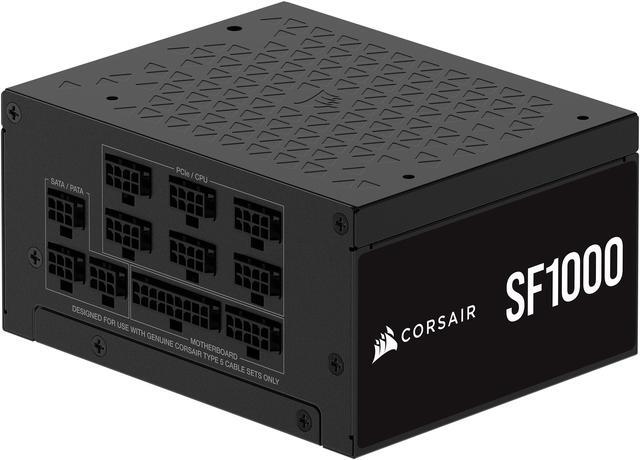


Corsair SF Series (2024) SF1000, 80 PLUS Platinum, Fully Modular SFX Power Supply, CP-9020257-NA
- 80 PLUS Platinum rated SFX power
- ATX 3.1 Compliant & PCIe 5.1 ready
- Fully modular, Type-5 Micro-Fit PSU connectors
- 92mm PWM cooling fan
- 105°C Rated Japanese capacitors
- Zero RPM Mode
- 50°C Continuous operating temperature
- SFX-to-ATX bracket
- Seven-year warranty
+
+
Overview
Specs
Reviews (274)
SF SERIES (2024), SF1000, 1000 WATT, SFX, 80 PLUS PLATINUM, FULLY MODULAR POWER
Warranty & Returns
Warranty, Returns, And Additional Information
Return Policies
- Return for refund within: 30 days
- Return for replacement within: 30 days
- This item is covered by Newegg.ca's Standard Return Policy.
- Read full return policy for details.
Manufacturer Contact Info
- Manufacturer Product Page
- Manufacturer Website
- Support Phone: 1-888-222-4346
- Support Website
- View other products from Corsair
LOADING...
LOADING...
The Corsair SF1000 (2024) is a 1000W fully modular SFX power supply with 80 PLUS Platinum efficiency, built for compact high-performance PCs that need ATX 3.1 and PCIe 5.1 readiness. It suits small-form-factor gaming, creator, and workstation builds where space is tight but GPU and CPU power demands are high.
Recommended For
- Small-form-factor builders pairing a flagship GPU with a high-end CPU, especially in ITX cases where SFX size is mandatory but ATX 3.1 / PCIe 5.1 support is expected for newer graphics cards.
- Enthusiasts building dense gaming or creator PCs who want top-tier SFX electrical performance and strong transient handling rather than just fitting the cheapest compact PSU that works on paper.
- Users moving a premium SFX unit between compact and standard towers, since the included SFX-to-ATX bracket makes sense for builds that may start in ITX and later move into a larger case.
- Builders who care about cleaner cable routing in tight chassis and want short, modular Type-5 micro-fit cabling designed around space-constrained layouts instead of managing full-size ATX PSU bulk.
- Buyers prioritizing efficiency and low-load fan stop behavior in a high-end SFF system, where Zero RPM operation and Platinum-class efficiency matter for everyday desktop use as much as gaming load.
Real-World Use Scenarios
- Building a high-end mini-ITX gaming PC with a modern flagship GPU: the SF1000 is commonly used when builders want true SFX size instead of SFX-L, so it is more likely to fit tight small-form-factor cases while still supporting current high-power graphics cards through ATX 3.1 / PCIe 5.1 cabling.
- Replacing an SFX-L unit in a cramped case to improve clearance: users moving to the 2024 SF1000 typically do it to gain extra room for cable routing, side panels, or front-mounted hardware, with the tradeoff that the included SFX-length cables are optimized for compact builds rather than large towers.
- Using the same PSU for gaming, work, and everyday desktop use: in light and moderate workloads, owners can expect little to no fan noise much of the time because the unit runs fanless at lower loads, so the PSU is usually not the main acoustic source during web, office, or mixed-use sessions.
- Running sustained gaming or creator loads in a small chassis: the SF1000 is intended for dense, high-wattage systems and review testing shows it can handle full rated output at elevated temperatures, but under heavier load the small 92 mm fan becomes more noticeable than it is at idle or mid-load.
- Installing it in a standard ATX case as a temporary or space-saving solution: the included SFX-to-ATX bracket makes this practical, but real-world builders should expect the short native cable lengths to be the main limitation compared with a full-size ATX power supply.
- Upgrading from an older Corsair SF model or reusing custom cables: in practice, this is not a drop-in cable ecosystem upgrade, because the 2024 SF series uses a newer Type-5 Micro-Fit cabling setup, so builders should plan on using the bundled cables or ordering confirmed-compatible replacements.
Spec Summary
| Attribute | Value |
|---|---|
| Best For | Compact SFX desktop builds requiring up to 1000 W and compatibility with ATX 3.1 / PCIe 5.1 components |
| Model Identifiers | CORSAIR SF Series SF1000 — model CP-9020257-NA |
| Capacity | 1000 W output |
| Form Factor & Compatibility | SFX form factor, fully modular design, maximum PSU length 125 mm, style lists ATX 3.1 & PCIe 5.1 |
| Efficiency & Standards | 80 PLUS Platinum certified |
| Connectors & Cables | Fully modular cable set including 24-pin ATX (300 mm); 2× EPS/ATX12V 8-pin (4+4, 400 mm); 4× PCIe 8-pin (6+2, 400 mm); 1× PCIe 12+4-pin (400 mm); SATA cables (4 straight and 4 right; lengths 100 mm, 115 mm, 115 mm, 115 mm); PATA chain (100 mm, 115 mm, 115 mm) |
| Cooling & Thermal | Single 92 mm PWM cooling fan; upper temperature rating 105 °C |
| Input & Electrical | AC input 100–240 V, 47–63 Hz; input current listed as 12A–6A; DC outputs: +3.3V@20A, +5V@20A, [email protected], +5VSB@3A |
| Physical & Package | Compact SFX dimensions 4.92 × 3.94 × 2.50 inches, weight 2.31 lbs; package includes SF1000 power supply, DC cable kit, SFX‑ATX adapter bracket, power cord, mounting screws, cable ties; package quantity 1 |
| Additional Info | Color: Black; batteries not required and not included; listed compatible device: Monitor |
Reference Q&A
Q: Should I buy the Corsair SF1000 (2024) or Corsair SF850 (2024) for a compact gaming PC?
A: Choose the Corsair SF1000 (2024) if you want more headroom for high-end GPUs, heavier transient loads, or future upgrades while staying in a true SFX form factor. Choose the SF850 (2024) if your system is already well within 850W and you want the same 2024 SF platform features, including ATX 3.1 support and compact dimensions, without paying for extra capacity you may not use. In practice, the SF1000 is the better fit for RTX 4080/4090-class SFF builds or users prioritizing upgrade flexibility, while the SF850 is the more efficient choice for balanced high-performance builds that do not need 1000W.
Q: Is the Corsair SF1000 (2024) better than the older Corsair SF1000L for SFF builds?
A: The SF1000 (2024) is the stronger choice when case compatibility and cable clearance matter most, because it uses the smaller true SFX format rather than SFX-L. It also updates the platform to ATX 3.1 and PCIe 5.1, which makes it the more current option for modern GPUs and compact builds. The SF1000L still makes sense when an SFX-L unit fits comfortably and you prefer that product class, but the 2024 SF1000 is usually the easier recommendation for tighter small-form-factor layouts.
Q: Corsair SF1000 (2024) vs ASUS ROG Loki 1000W SFX-L: which one should I choose?
A: Choose the Corsair SF1000 (2024) if compact size is the priority and you want a 1000W unit in true SFX dimensions for easier installation in tighter cases. Choose the ASUS ROG Loki 1000W SFX-L if your case has room for SFX-L and you specifically want that product’s feature set, such as its larger chassis and design approach. Across reviews and community discussions, the practical trade-off is usually size and fitment: the SF1000 is easier to recommend for space-constrained SFF systems, while the Loki is a valid alternative in less restrictive builds.
Q: Should I get the Corsair SF1000 (2024) or Cooler Master V SFX Platinum 1100?
A: Choose the Corsair SF1000 (2024) if you want a newer ATX 3.1-based Corsair SFX design with 1000W capacity and broad appeal for premium compact builds. Choose the Cooler Master V SFX Platinum 1100 if you specifically need more than 1000W in an SFX-class power supply and your build justifies the extra output. The main decision is capacity versus platform generation: the Cooler Master gives you more wattage, while the Corsair focuses on current-standard support, compact integration, and a capacity level that already covers most high-end SFF gaming systems.
Q: Is the Corsair SF1000 (2024) worth it over a lower-wattage SFX PSU for portability-focused builds?
A: The SF1000 (2024) is worth choosing over a lower-wattage SFX PSU when you want one compact PSU that can handle both a current build and a later GPU or CPU upgrade without changing form factor. For portability-focused builds that use efficient midrange or upper-midrange parts, a lower-wattage SFX model is often the more practical choice because it keeps the same size class and may better match actual power draw. The SF1000 makes the most sense when you want compact dimensions without limiting component choices later.
Q: Will this fit a typical Mini-ITX or other small-form-factor PC case?
A: Usually yes, if the case supports the SFX power supply form factor. The Corsair SF1000 is an SFX unit and is designed for compact builds. It can also work in some larger cases by using the included SFX-to-ATX bracket, but buyers should still confirm the case's PSU clearance and cable-routing space before purchase.
Q: Is this a good choice for a high-end SFF gaming build with a next-gen GPU?
A: Yes, for many high-end SFF gaming builds this is a strong fit. It provides 1000W capacity, 80 PLUS Platinum efficiency, ATX 3.1 compliance, and a native 12V-2x6/12+4-pin GPU cable, so it is better suited than older SFX models for newer power-hungry graphics cards. The main trade-off is cost and the tighter cable space that comes with compact PSUs.
Q: Is the SF1000 better than a 750W SFX power supply, or is 1000W overkill?
A: Choose the SF1000 if you are pairing a powerful CPU and a high-end modern GPU, want more upgrade headroom, or specifically need ATX 3.1 and PCIe 5.1-era readiness. A 750W SFX unit is often enough for more moderate gaming or productivity builds and may be the better value. The SF1000 is the safer choice for top-tier parts, but it is not necessary for every SFF build.
Q: What are the main trade-offs versus an ATX power supply?
A: The main advantage is size: the SF1000 is much easier to fit into compact SFF cases. The trade-offs are usually higher price per watt, shorter cable runs that may be less ideal in large towers, and tighter installation space for cable management. If you are building in a standard ATX case and do not need a compact PSU, a full-size ATX model can be more economical.
Q: Is the warranty and long-term reliability good enough for a premium build?
A: It is reasonable for a premium SFX build. The SF1000 uses 105°C-rated Japanese capacitors, supports continuous operation at up to 50°C, and includes a seven-year warranty. That makes it credible for long-term use, though some buyers may still prefer ATX alternatives that offer longer warranty periods if compact size is not required.
Q: Is the Corsair SF1000 (2024) worth buying over the SF850?
A: It makes the most sense for small-form-factor builders who want 1000W in true SFX size, ATX 3.1 support, and a native 12V-2x6/12+4-pin GPU cable. If the price gap versus the SF850 is small, the SF1000 is the more flexible long-term choice. If your system is clearly below this power class, the SF850 is usually the better value.
Q: Who is the Corsair SF1000 (2024) actually suitable for?
A: It is best suited to high-end SFF PCs that need full 1000W capacity in a compact SFX form factor, especially builds using power-hungry CPUs and newer GPUs that benefit from ATX 3.1 and PCIe 5.1 readiness. It is less suitable for mid-range builds that do not need this much headroom, because you are paying for capacity and features you may not use.
Q: Are there any common trade-offs or concerns with the Corsair SF1000 (2024)?
A: Yes. The main trade-offs discussed by buyers are cost, the shorter seven-year warranty compared with some competing SFX units, and occasional user reports of noise issues such as coil whine or fan-related noise. Those reports are not universal, but they are common enough to treat acoustic sensitivity as a real consideration.
Q: Is the Corsair SF1000 (2024) a good choice for quiet SFF builds?
A: It can be, but it is not the safest choice if low noise is your top priority. On paper it has Zero RPM mode and a 92mm PWM fan, which helps at low load, but Reddit discussions show mixed real-world noise experiences. Some users report silent operation, while others report coil whine or fan noise. For noise-sensitive builds, it is a good option only if you are comfortable with the possibility of returning or exchanging a unit.
Q: Is the included cabling good enough for modern high-end GPU SFF builds?
A: Generally yes. The included native 12+4-pin GPU cable and fully modular Type-5 cabling make it practical for modern high-end GPUs, and this is one reason it appears often in SFF build discussions. The main limitation is not feature support but fit: in very tight cases, builders may still prefer custom-length or angled cables for cleaner routing.