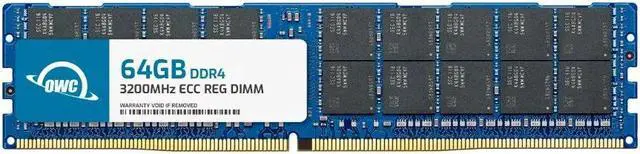
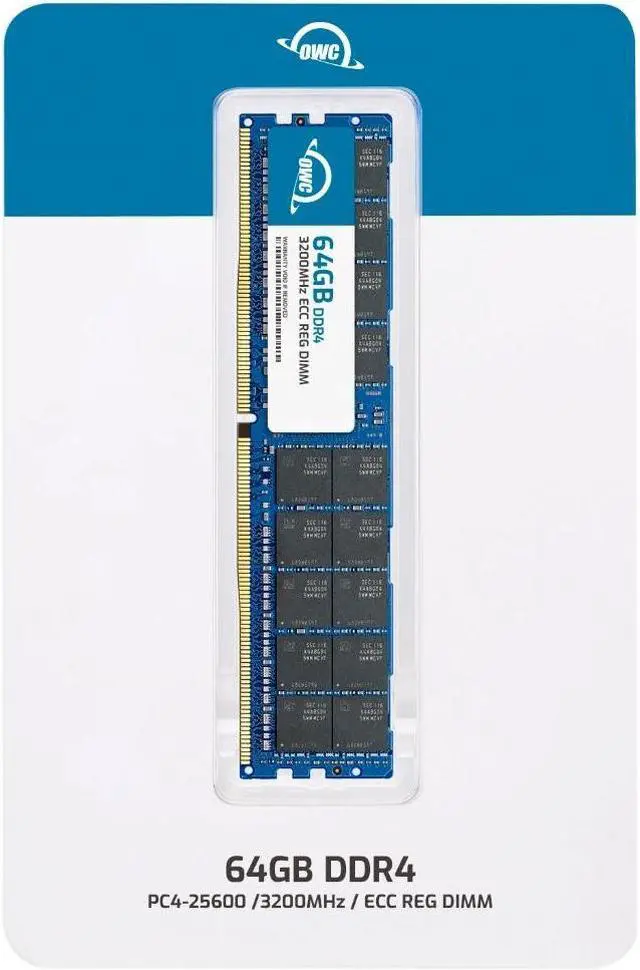
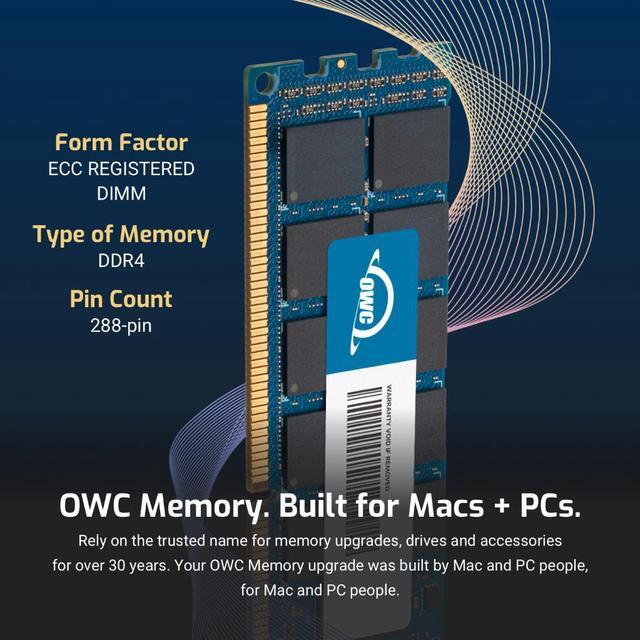
The OWC 3R2D42R464GB is a single 64GB DDR4-3200 ECC Registered RDIMM for compatible Gigabyte servers, including the R272-Z34, R281-Z91, R281-Z92, R281-Z94, and R282-2O0. It suits server upgrades requiring registered memory, rather than standard desktop systems.
Recommended For
- IT administrators expanding memory in a listed Gigabyte server—such as the R272-Z34 or R281-Z92—who need a 64GB ECC registered DIMM for server workloads. Check the server revision, CPU, memory population rules, and QVL before expecting a particular operating speed.
- Operators of supported server platforms running memory-intensive data analytics, HPC, or cloud workloads who are upgrading server RAM capacity. GIGABYTE positions its EPYC server systems for these workload categories.
- Server maintainers replacing or adding a single DIMM in a listed compatible Gigabyte system who specifically need ECC registered memory; this is a server-memory module, not a general-purpose desktop upgrade.
- Administrators upgrading a GIGABYTE R282-2O0 and seeking a 64GB ECC registered module; GIGABYTE lists 64GB 2Rx4 RDIMMs in that system’s memory qualification information.
Real-World Use Scenarios
- When a compatible Gigabyte server is short on memory for virtual machines, adding this module as part of a supported memory configuration can give the host more RAM to allocate across guests and help ease memory pressure. The benefit depends on the workload and existing memory layout.
- For a database server under memory pressure, additional RAM can let the database keep more frequently used data pages in memory, potentially reducing disk reads. The improvement depends on whether limited memory is actually the bottleneck and on the database’s memory settings.
- For big-data analytics or HPC jobs on a compatible server, adding memory can provide more room for data and working sets in RAM, which may help when the current workload is constrained by memory. It does not by itself guarantee faster job completion.
- On a compatible GPU server used for AI training or inference, extra system RAM can provide more headroom for host-side data handling alongside the GPUs. It does not increase GPU memory or remove a GPU-side memory limit.