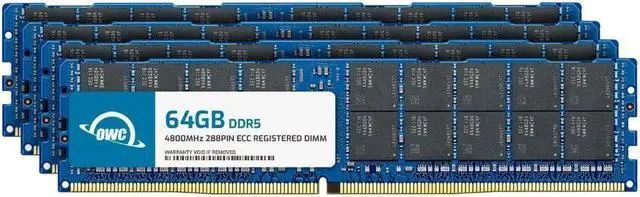
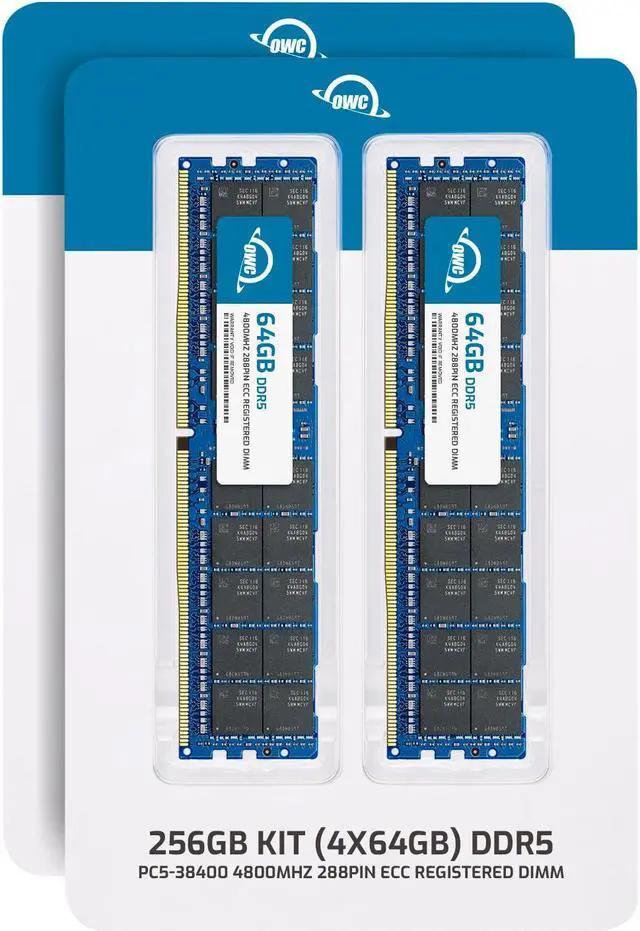
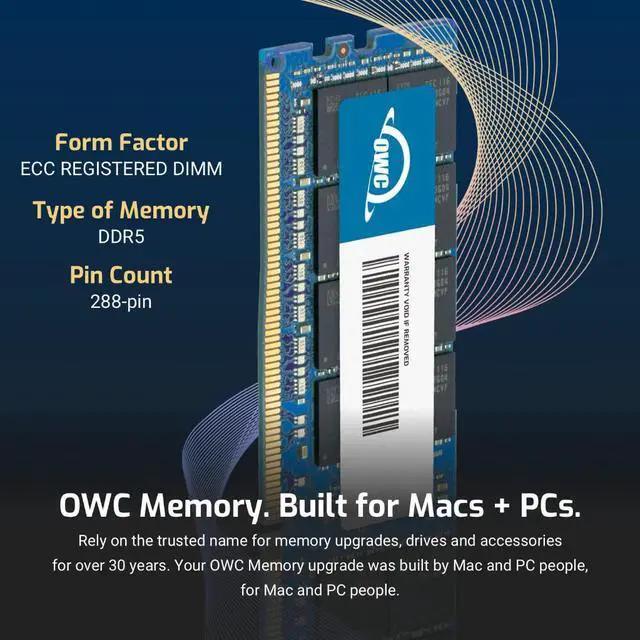
The OWC 256GB DDR5-4800 ECC Registered RDIMM kit is a four-module server memory upgrade for Lenovo ThinkSystem SD650 V3, SD650-I V3, SD665 V3, SD665-N V3, and SR630 V3 systems.
Recommended For
- IT administrators expanding memory in a compatible ThinkSystem SD650 V3, SD650-I V3, SD665 V3, SD665-N V3, or SR630 V3; the four 64GB ECC registered DIMMs provide a 256GB upgrade for server workloads.
- Operators running virtualization or VDI on a compatible SR630 V3 who need more memory for multiple virtual machines or virtual desktops; Lenovo identifies these as SR630 V3 workloads.
- Database and enterprise-application administrators whose compatible ThinkSystem servers need added memory capacity for larger workloads; Lenovo lists databases and enterprise applications among SR630 V3 use cases.
- Research and engineering teams adding memory to compatible SD650 V3 or SD665 V3 nodes used for simulations, modeling, analytics, or other HPC work; Lenovo positions these systems for those workloads.
Real-World Use Scenarios
- When upgrading a compatible SR630 V3 host for virtualization, an administrator can use the memory kit as part of a supported configuration to give multiple virtual machines more room to run without competing as quickly for host memory.
- For database or analytics workloads on a compatible ThinkSystem server, a memory upgrade can provide more space for working data and larger in-memory operations; the actual benefit depends on the application and server configuration.
- In an SD650 V3 HPC cluster, administrators can use a supported memory configuration to give scientific simulations more working space for data-heavy jobs, such as computational biology or chemistry workloads.
- For virtual desktop infrastructure on a compatible SR630 V3, additional installed memory can help the host support more concurrent desktop sessions, provided the CPU, storage, software, and total memory configuration are also adequate.
- When a compatible ThinkSystem server is used for AI or machine-learning infrastructure, this kit can contribute host memory for data handling and supporting services; it does not replace the need for suitable processors, accelerators, or a validated memory layout.