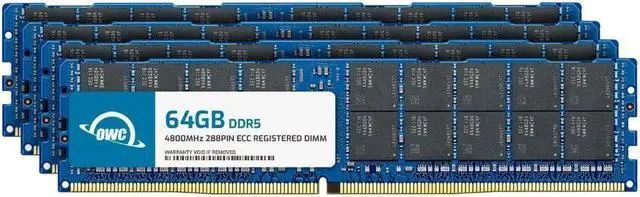
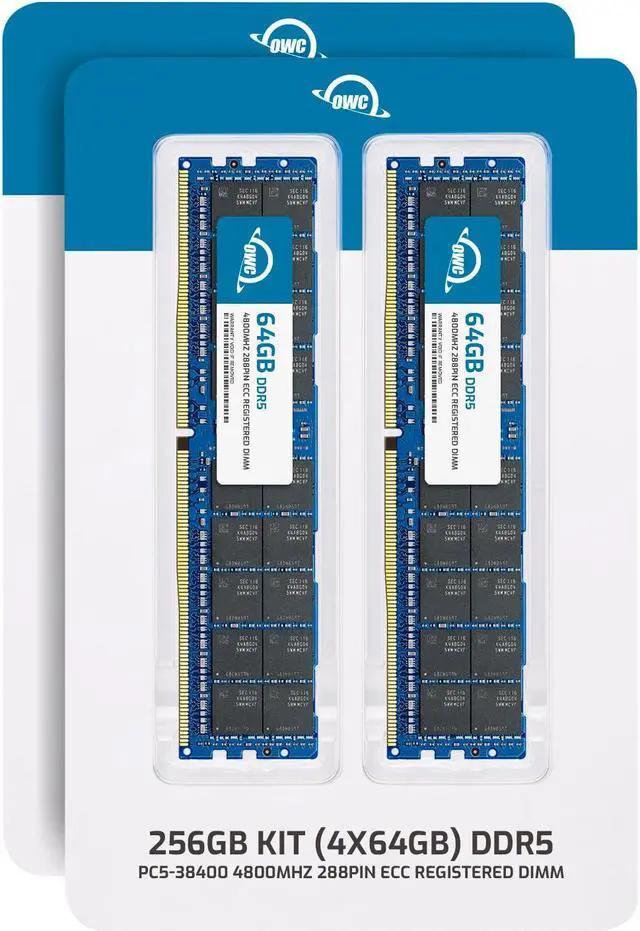
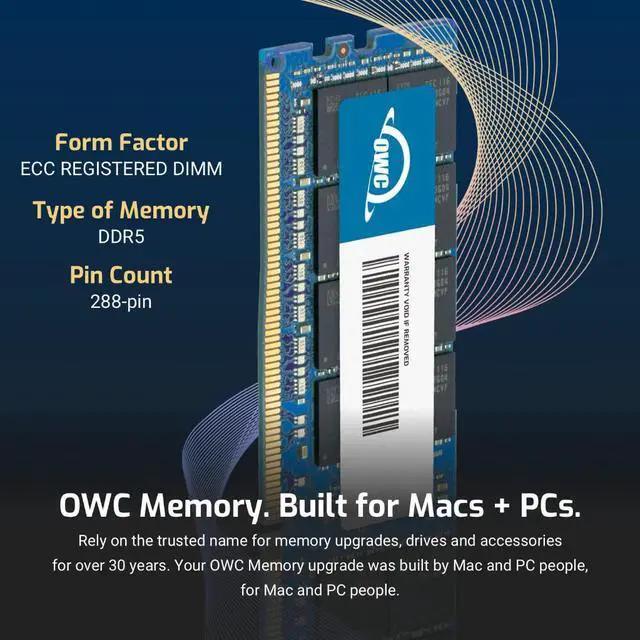
The OWC 256GB DDR5-4800 ECC Registered RDIMM kit adds four 64GB modules to compatible Lenovo ThinkSystem SR635 V3, SR645 V3, SR650 V3, SR655 V3, or SR665 V3 servers—an upgrade for server users who need more memory capacity with ECC support.
Recommended For
- IT administrators adding memory to a listed ThinkSystem SR635 V3, SR645 V3, SR650 V3, SR655 V3, or SR665 V3 for server virtualization or cloud hosting. Check the server’s processor, firmware, and DIMM population rules before installing the four-module kit.
- Database and analytics operators upgrading a compatible ThinkSystem server when its current memory capacity is limiting the workload’s working set. This is a capacity upgrade, not a guarantee of faster queries.
- VDI or enterprise application teams expanding memory in a supported ThinkSystem deployment, where additional server RAM can accommodate more concurrent workloads if the system configuration supports it.
- Server operators refreshing a compatible system with ECC registered memory for data-intensive workloads such as HPC or in-memory analytics, provided the server’s CPU and memory configuration support this 4800 MT/s, 2Rx4 RDIMM kit.
Real-World Use Scenarios
- When a ThinkSystem server is running many virtual machines, an administrator can add memory to give those VMs more room to run together; the practical benefit depends on whether memory is currently limiting the host.
- For a database whose working set is constrained by available RAM, adding memory can let more data remain in memory and support more concurrent activity; it does not by itself guarantee faster queries.
- In a virtual desktop infrastructure (VDI) deployment, an operator can expand memory available to desktop sessions and supporting services, which may help when the host is short on RAM; session capacity also depends on the processors, storage, and software configuration.
- For analytics workloads that keep datasets or working data in memory, adding RAM can provide more room for those jobs to run; the result depends on the workload and whether memory is the bottleneck.