


- Free 84-day Returns
$404.99
Add to PC build list
Ships from United States.
Sold by Newegg
Shipped by Newegg




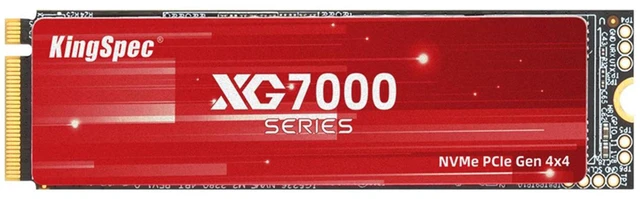





KingSpec XG7000 2TB M.2 2280 PCIe Gen 4.0x4 NVME 1.4 Speed up to 7400MB/s Write Speed Up to 6600MB/s Internal Solid State Drive for PS5 PC Desktop Laptop Gaming (XG7000-2TB) - OEM
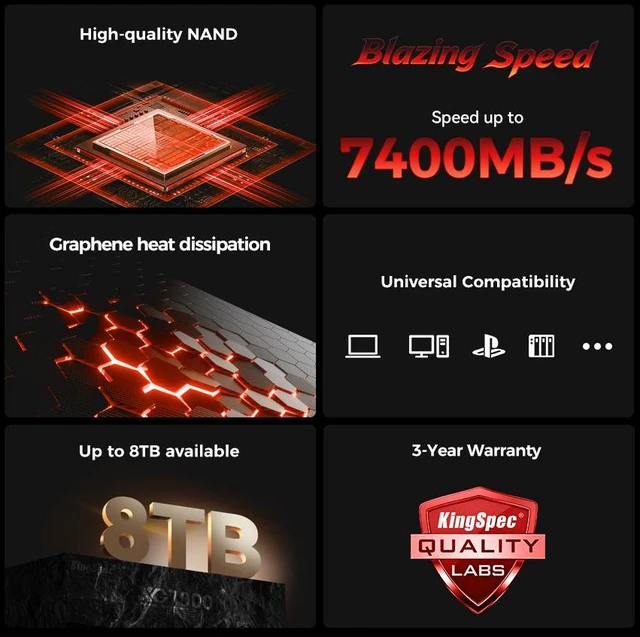
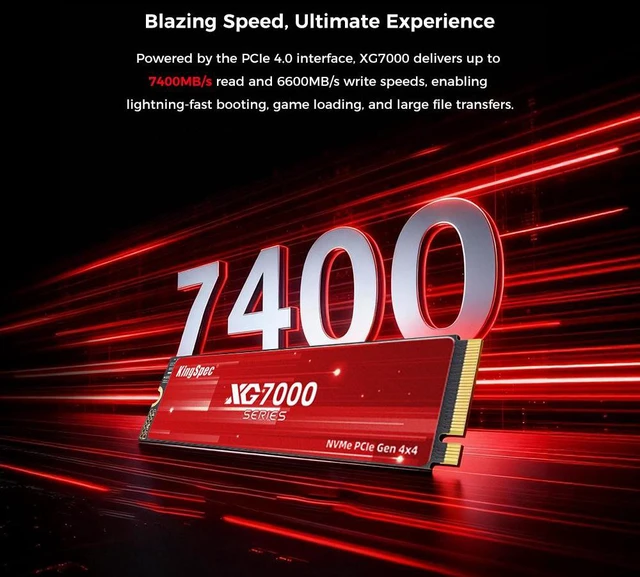
- · High-speed Performance: The XG 7000 SSD offers exceptional performance with read speeds of up to 7400MB/s. Upgrade to the PCIe Gen4 x 4 interface to experience a substantial performance improvement over PCIe 3.0, while maintaining backward compatibility with PCIe 3.0.
- · Ultra-thin Heat Sink: The XG 7000 NVMe SSD features an innovative graphene-based thermal solution with an integrated heat spreader. This cutting-edge technology provides efficient heat dissipation, ensuring optimal operating temperatures and enhancing overall system stability.
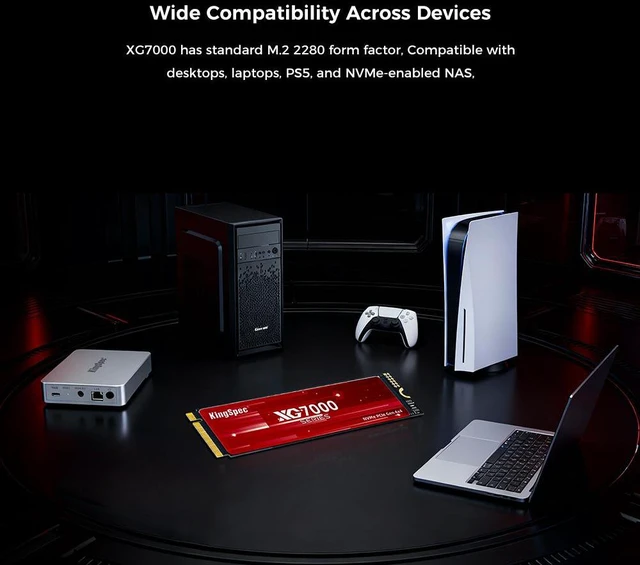
- · M.2 Form Factor: With a compact M.2 form factor measuring 80.0mm (L) x 22.0mm (W) x 2.1mm (H), the XG 7000 is designed for easy installation and compatibility with various devices such as laptops, desktops, and PS5.
+
+
Specs
Reviews (45)
Learn more about the KingSpec XG7000-2TB
| Brand | KingSpec |
|---|---|
| Series | XG7000 Series |
| Model | XG7000-2TB |
| Part Number | XG7000-2TB |
| Device Type | Internal Solid State Drive (SSD) |
| Used For | Consumer |
| Form Factor | M.2 2280 |
|---|---|
| Capacity | 2TB |
| Memory Components | 3D NAND TLC |
| Interface | PCI-Express 4.0 x4 |
| Protocol | NVMe 1.4 |
| Max Sequential Read | Up to 7400 MBps |
|---|---|
| Max Sequential Write | Up to 6600 MBps |
| 4KB Random Read | Up to 720,000 IOPS |
| 4KB Random Write | Up to 800,000 IOPS |
| Terabytes Written (TBW) | 1200TB |
| MTBF | 1,000,000 hours |
| HeatSink | without HeatSink |
| Power Consumption (Idle) | 0.66W |
|---|---|
| Power Consumption (Active) | 8.18W |
| Operating Temperature | 0°C ~ +70°C |
| Storage Temperature | -25°C ~ +75°C |
| Operating Humidity | 5-95% |
| Height | 80.0mm |
|---|---|
| Width | 22.0mm |
| Depth | 2.10mm |
| Weight | 10g |
| First Listed on Newegg | November 03, 2026 |
|---|
Warranty & Returns
Warranty, Returns, And Additional Information
Warranty
- Limited Warranty period (parts): 3 years
- Limited Warranty period (labor): 3 years
- Read full details
Return Policies
- Return for refund until: January 31, 2027
- Return for replacement until: January 31, 2027
- This item is covered by Newegg.ca's Extended Holiday Return Policy.
- Read full return policy for details.
We want to ensure your holiday shopping this year is hassle-free. That’s why we’re automatically extending our return policies on almost every product! For purchases placed between November 1st, 2026 and December 31, 2026 you will have until January 31, 2027 to return your product.
Manufacturer Contact Info
- Manufacturer Product Page
- Manufacturer Website
- Support Phone: 860755-26985389
- Support Email: info@kingspec.com
- Support Website
- View other products from KingSpec
LOADING...
The KingSpec XG7000 2TB is an M.2 2280 PCIe 4.0 x4 NVMe SSD for PS5, desktop, and laptop storage upgrades, with sequential speeds up to 7,400 MB/s read and 6,600 MB/s write for users seeking fast game and file loading.
Recommended For
- PC gamers adding a 2TB game library drive to a desktop with an M.2 2280 PCIe 4.0 slot; an independent test identifies the tested XG7000 2TB as a TLC drive and reports benchmark performance close to its rated sequential speeds.
- PS5 owners who want more space for installed games and are prepared to add a compatible heatsink; the drive’s 2280 size and PCIe 4.0 interface match PS5’s supported M.2 types, but Sony requires effective heat dissipation.
- Laptop owners upgrading a machine with an open M.2 2280 PCIe 4.0 slot who want 2TB of internal storage without a bulky drive heatsink; check the laptop’s supported drive length and thermal clearance before buying.
- PC users moving from a smaller or slower SSD who want a single 2TB drive for games and everyday applications, and whose system supports PCIe 4.0 x4 to make use of the drive’s higher advertised transfer speeds.
Real-World Use Scenarios
- PS5 game-library expansion: Install the XG7000 in a compatible M.2 slot to keep more games on the console’s internal storage; a hands-on test covers installation, game transfers, and gameplay with an XG7000.
- Gaming desktop storage upgrade: Use it to add space for a PC game library or install games on a compatible PCIe 4.0 M.2 slot; benchmark testing reports performance near the drive’s rated sequential speeds, though game-loading times vary by title and system.
- Laptop capacity upgrade: In a laptop with a compatible M.2 2280 NVMe slot, use the 2TB drive to replace or supplement existing storage for a larger collection of games, apps, and files; confirm the laptop supports this size and interface before buying.
- Everyday PC responsiveness: Use it as a Windows system drive or app drive in a compatible desktop or laptop; it provides NVMe storage for booting and launching programs, while the experience also depends on the computer and workload.
- Large-file transfers on a PC: Copy sizable files or project folders between compatible fast drives; the XG7000’s sequential performance can help with these transfers, but actual speeds depend on the other drive, connection, and file mix.
Spec Summary
| Attribute | Value |
|---|---|
| Best For | Consumer internal storage upgrades for systems with an M.2 2280 slot |
| Capacity And NAND | 2TB capacity with 3D NAND TLC |
| Interface And Form Factor | M.2 2280 drive using PCIe 4.0 x4 and NVMe 1.4; measures 80.0 × 22.0 × 2.10 mm and weighs 10 g |
| Read Write Performance | Sequential speeds up to 7400 MB/s read and 6600 MB/s write; 4KB random performance up to 720,000 IOPS read and 800,000 IOPS write |
| Endurance And Reliability | Rated for 1200 TBW and 1,000,000 hours MTBF |
| Power And Operating Conditions | Power consumption: 0.66 W idle and 8.18 W active; operating temperature 0°C to +70°C, storage temperature -25°C to +75°C, and operating humidity 5–95% |
| Model Identifiers | KingSpec XG7000 Series, model and part number XG7000-2TB |
Reference Q&A
Q: KingSpec XG7000 2TB or Samsung 990 PRO 2TB—which should I buy?
A: Choose the XG7000 if you want 2TB of PCIe 4.0 storage and its listed price is lower. Their advertised sequential speeds are close: 7,400/6,600 MB/s read/write for the XG7000 versus 7,450/6,900 MB/s for the 990 PRO. Choose the 990 PRO if you value its specified DRAM cache and five-year limited warranty; Samsung lists 2GB of DRAM for the 2TB model. These are manufacturer speed ratings, not a guarantee of equivalent performance in every workload.
Q: Can I use the KingSpec XG7000 2TB in a PS5, or should I get a heatsink model?
A: The XG7000’s M.2 2280 form factor and PCIe Gen4 x4 interface match PS5-supported drive types, but the Newegg specifications list this version as without a heatsink. Sony says an M.2 drive without a heat-dissipation mechanism needs one added. Choose this drive for a PS5 only if you confirm the package includes a suitable heat spreader or you plan to add a PS5-compatible cooling solution that fits the console.
Q: Is the KingSpec XG7000 2TB worth choosing over a PCIe Gen3 SSD?
A: Choose the XG7000 when your computer supports PCIe Gen4 x4 and you want higher rated sequential speeds: up to 7,400 MB/s read and 6,600 MB/s write. A Gen3 drive is a sensible alternative for a Gen3-only system or a lower-cost build, since the XG7000 is backward-compatible but cannot deliver its Gen4-rated speeds in a Gen3 slot.
Q: Should I get the 1TB or 2TB KingSpec XG7000?
A: Choose the 2TB model if you need room for a larger game library or more files; KingSpec lists the 1TB and 2TB 2280 versions with the same maximum sequential speeds of 7,400 MB/s read and 6,600 MB/s write. Choose 1TB if that capacity is sufficient and it offers better value at the price you find.
Q: Will the XG7000 work in a PS5?
A: Its listed 2TB capacity, M.2 2280 size, PCIe Gen 4 x4 NVMe interface, and up-to-7400 MB/s read speed match key PS5 SSD criteria. PS5 installation also requires effective cooling. The listing is inconsistent about cooling: its specifications say “without HeatSink,” while its description mentions a graphene-based heat spreader. Confirm the included cooling solution and add a PS5-compatible heatsink if needed before installing.
Q: Is this SSD compatible with my PC or laptop?
A: It is designed for a system with an M.2 2280 slot that supports NVMe over PCIe. Check the computer or motherboard specifications first: an M.2 slot that supports SATA only, or a different drive length, may not be compatible. The product listing says it can also operate with PCIe 3.0, though the system will affect performance.
Q: Does the XG7000 come with a heatsink?
A: The product information is conflicting: the specifications say “without HeatSink,” but the description mentions an integrated graphene-based heat spreader. It does not clearly confirm that a dedicated heatsink is included. Check the package details with the seller, and plan on a separate compatible heatsink if your device requires one.
Q: Will it reach 7400 MB/s in my computer?
A: 7400 MB/s is the listed maximum sequential read speed, not a guaranteed speed in every system. Reaching the advertised maximum requires a compatible PCIe Gen 4 x4 NVMe slot; in a PCIe 3.0 system, the drive can run at the supported lower interface speed. Actual results also depend on the host system and workload.
Q: Is the KingSpec XG7000 a dependable choice for a boot drive or important files?
A: Community reports are mixed: some XG7000 owners describe trouble-free use, while others report failures or instability. One 2TB owner reported crashes during intensive writes at PCIe Gen 4. These reports do not establish an overall failure rate; keep backups, especially for important files.
Q: Does the XG7000 have a DRAM cache?
A: A Reddit discussion identifies the non-Pro XG7000 as lacking a DRAM cache. The supplied product specifications do not list a cache, so verify the exact model if DRAM is important to your decision.
Q: Will it sustain its advertised write speed during long or repeated transfers?
A: The listed 6,600 MB/s write speed is a maximum sequential rating, not a guarantee for every workload. A Reddit user reported lower write speeds on a repeated test, and another reported Gen 4 instability during intensive writes. Results may depend on the system and workload.