
Your Browsing History


RODERICK P.
Joined on 11/08/06
0
1

product reviews
- 39
Great board, could have been perfect
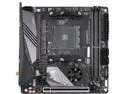
GIGABYTE X570 I AORUS PRO WIFI AMD Ryzen 3000 PCIe 4.0 SATA 6Gb/s USB 3.2 AMD X570 Mini-ITX Motherboard
Pros: Stable and fast. GIgabyte is killing it with timely delivery of new BIOS revisions that only improve stability, add functionality, and speed things up. Consistently the best with the x570 generation
Cons: No RAM VRM LLC settings and the droop from unloaded/idle DRAM to fully hammered makes tuning out memory a chore on this thing compared to my Asus Crosshair VII build. Its problematic at best and, despite how otherwise thrilled I am with it, will give me serious pause when shopping for my next motherboard. If Gigabyte gave me some more control or improved the droop for vDRAM, I would simply shop them exclusively.
Overall Review: This is well worth your money. I have a 3700x/2080Ti Vive Pro Wireless rigged up to this board with 2x16GB Trident Royal 4000 CL19 running @ 3666MT 14-14-14-14-28-42 and ~64ns latency in AIDA64. The Vive Wireless adapter is connected to a Newegg sourced m.2 NVME to PCIe 16x physical, 4x electric adapter flawlessly. It is refreshing to have a motherboard OEM commit to producing timely and bug free BIOS updates while adding new functionality along the way.
10/11/2019See more detail
Not so good
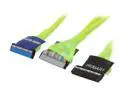
Link Depot Model UV-ATA36-YE-3 36" 3 Connectors Yellow ATA133 UV Cable
Pros: despite seemingly good assembly, materials this cable is unable to transfer data without dropped bits and resulting file i/o errors
Cons: not worth the cost of RMA process
Overall Review: Iwas oping that this cable would be build with cheating that ATA specification for cable length and achieve reliable operation. This one didn't for me and I would bet wouldn't for you unless you have particularly accomidaing hardware. Problem confrimed by swapping cable out for plain jane ribbon and issures disappeared. Problems reproduced with different motherboard and hard disk/ Dvd rw combo. Both PCs powered by PC Power and Cooling Silencer 750
2/17/2008See more detail
Three Eggs for Linux, 5 for Windows
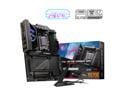
MSI MPG X870E CARBON AM5 ATX Gaming Motherboard, 4x SATA 6Gb/s, AMD Wi-Fi 7,USB 4.0
Pros: Nice build quality. Awesome UEFI, coming from someone who has been using Asus exclusively since the 90s I am not sure what that is worth. Can configure PCIe lane splits with more granularity than the manual or marketing materials suggest Network adapters run well on Windows M.2 Heatsinking on both sides for all four slots so your drive won't be bowing under the strains while getting poor thermal conductivity. WIndows or Linux all USB ports are fast, reliable, and the least picky I have seen when it comes to throughput on brand X generics. I have a USB C cable that on Asus x470 and x570 solutions could never transfer reliably more than about 4Gbp/s on 10Gpb/s ports that have no trouble sustaining 1GBp/s on this boards ports with the same Samsung T7 drives
Cons: Awful linux performance w/ the integrated wifi and if your distro of choice doesn't have a recent enough kernel to support it... well, it was a P.I.T.A for this user of 3 years to get it remotely serviceable. Then, the latency is quite variable and the throughput ranges from poor to unforgiveable where in windows I can reliably get 850Mbp/s speedtestdotnets or LAN transfers. How bad? Typically averages out to 150Mbp/s from a sn850x drive to another that is in a machine wired w 2.5Gbp/s ethernet. The wired performance isn't nearly as poor but it still only performs at about 75% of Windows... I resorted to just buying an add in intel WiFi adapter to have acceptable wireless functionality and live w/ the wired. No OpenRGB support for board lighting. Only 4 SATA ports.
Overall Review: TL;dr: If you have need or serious want for the perks this board offers and are going to be using Windows, I think it is sufficient product for the cash outlay of $500. I'd say about 85-90% of people will not miss a thing by going w/ a Tomahawk or lower tier chipset to power their build. If using Linux and are barely a pedestrian like me, make dammed sure your distro has integrated drivers that play nice with the networking solutions or swap out the WiFI adapter for an intel based card BEFORE you do final assembly and fill your loop. I am not certain I would choose a different board knowing what I do now. It has everything I need and a couple of really nice to haves in terms of I/O. I have made the transition to Linux and it suffices to say next time I will be very choosey when it comes to WiFi solutions on my next build. The lack of OpenRGB support is a bummer since I learned my lesson to not run motherboard manufacturer software back with my Asus A7n8x Deluxe build. I grudgingly love it and those are my thoughts having lived with it for 3 full months.
4/2/2025See more detail
Vive Pro wireless and x570/3700x ITX gaming
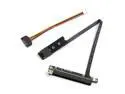
Graphics extension cable M.2 M2 to x16 PCIE For PC Mining 35CM Plug and Play
Pros: Built just well enough to leave no doubt about its reliability in long term service. Flawless performance in my application. Inexpensive
Cons: THe product listing does not specify, electrically, how many PCIe lanes it uses. Obviously it won't be the 16x but is it PCIe 1x operation only? PCIe 4x? Seems like an oversight that could be easily corrected.
Overall Review: I am using this to connect my Vive Pro WiGig PCIe 1x card to the Gigabyte Aorus x570 I(tx) Pro Wifi motherboard's "backside" NVME m.2 port and it works flawlessly. Since I am only using a PCIe 1x card with it and it functions perfectly I have few complaints personally but I do wish the product description would specify whether this adapter is good for only 1x operation or if it is electrically connecting up all 4 lane pairs available from the NVME m.2 slot it operates from.
1/12/2020See more detail
Simply the best
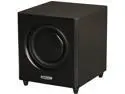
Polk Audio DSW microPRO 1000 8" 1200 watt Subwoofer Single
Pros: Exceptionally tight bass, exceptionally accurate, impressive output level regardless of size. Always proportionally correct output for set volume level throughout its stated dynamic range.
Cons: Newegg no longer carries the DSW Micropro 2000. Prefer Gloss black to the matte black
Overall Review: Quite simply the best sub I have ever heard except for the DSW MicroPro 2000 I bought before it. It totally redefined my standards for sound quality, especially where bass is concerned. This is not a good choice if you are more interested in feeling bass than hearing it correctly rendered at any output level. In practice and I have found its -3db lower limit to be 20hz as opposed to the advertised 22hz
7/31/2011See more detail
the beginnings of an audiophilliac start here
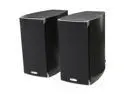
Polk Audio RTI A3-Black High Performance Bookshelf Loudspeaker Pair
Pros: I purchased a set of these speakers after spending many hours in a box box chain sampling everything they had in my price range which was <$500 USD pre tax. Where the TSI 200 wasn't crisp the RTi A series (both A1 and A3) where brutally detailed in comparison. The A3 has a nicer low end and honestly does not require a subwoofer. They are a wonderful sounding speaker. At very low levels of out put to so loud you have to leave the room for fear of damaging your hearing the RTi A3 stays pretty darned consistent in output level of the frequencies its given. You will run out of amplifier well before you run out of clean and consistent output from this speaker. The highs are the best part of this speaker, the midrange is brilliant unless you've heard some pretty solid gear (being in the $600 price range per pair, too many notables to list). Bass is the best and most accurate in the business at this price
Cons: For best imaging in my setup it seems necessary to place these speakers at or slightly below listening levels for the best imaging. IN this sense they have a kind of narrow window for their sweet spot.
Overall Review: Powered by a Yamaha C-2x preamp, Yamaha M-70 power amp. Amp has to hit just under 200 watts out consistent output to the speakers before distortion in certain harmonics are possible. I recalibrated the output meters for 6 ohm output. I am pretty confident it is simply the limit of the woofer cone material and not the voicecoil assembly. Astonishing! Solid buy and sure to not disappoint, especially at this price. Be prepared. It will sound significantly different from what you are used to if this is your first foray into quality speakers. These speakers easily and deftly reveal the recording quality of your music. From here on out, its gets very pricey to seriously and completely outdo this speaker.
3/24/2011See more detail