





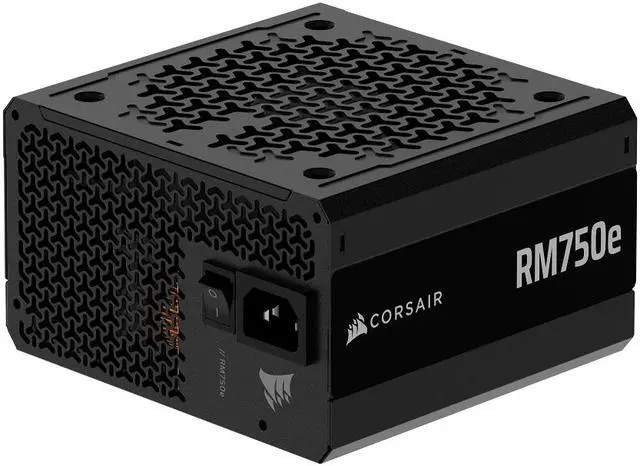
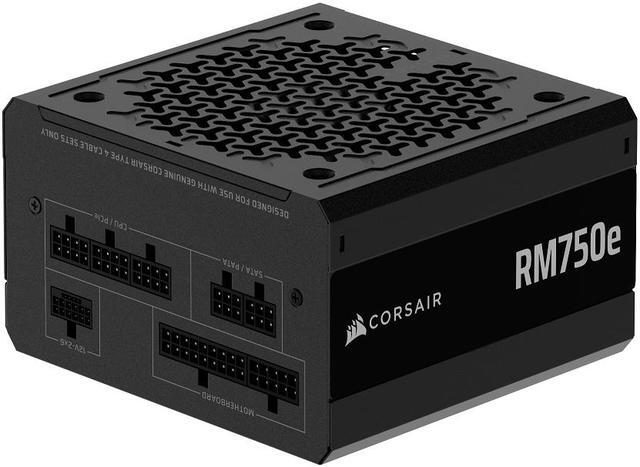
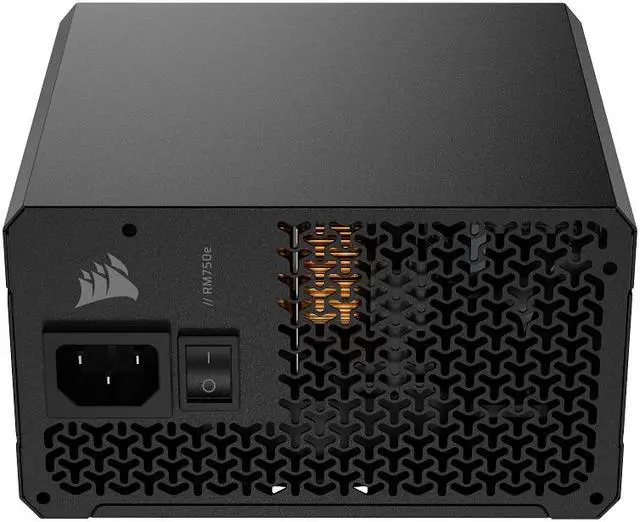
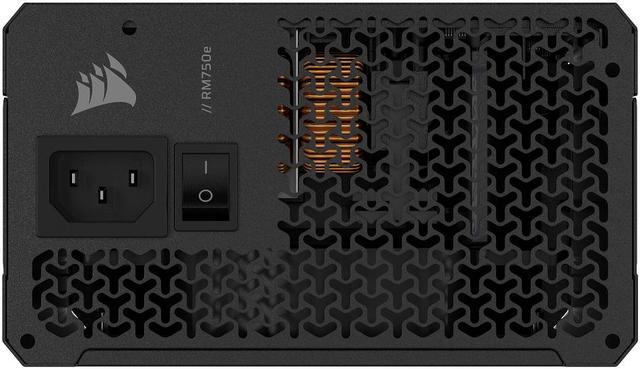
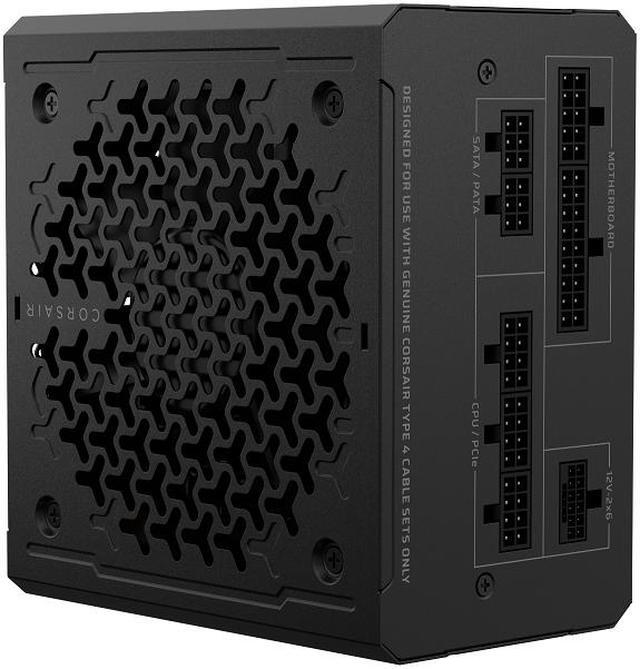
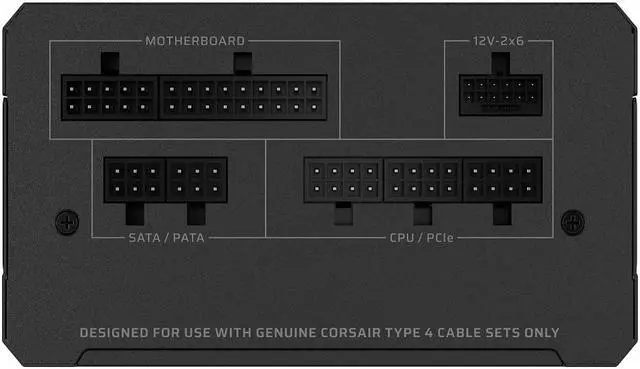
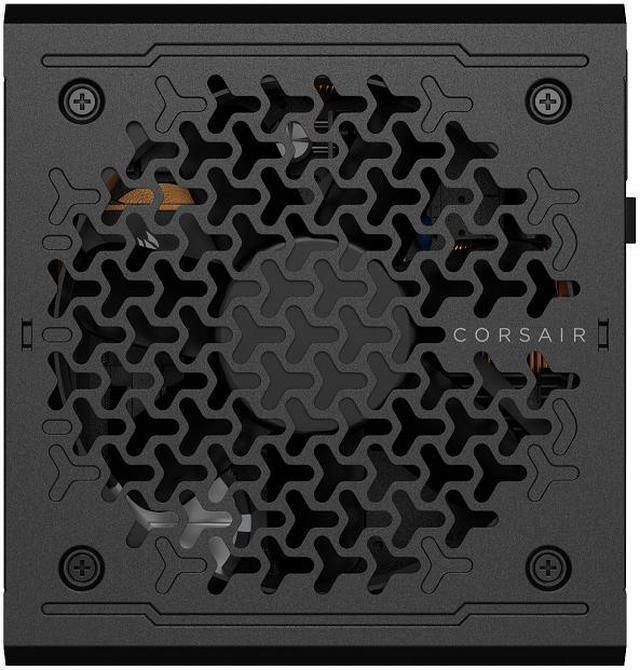
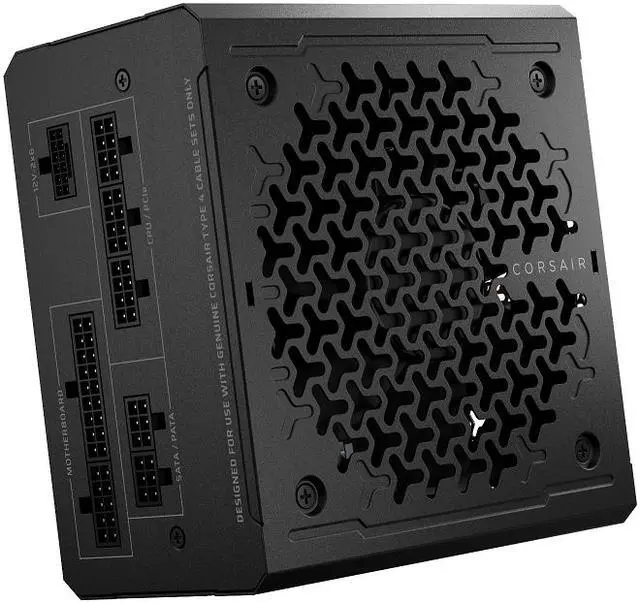


CORSAIR RM750e (2025) Fully Modular Low-Noise ATX Power Supply with 12V-2x6 Cable – ATX 3.1 & PCIe 5.1 Compliant, Cybenetics Gold Efficiency, 105°C-Rated Capacitors, Modern Standby Mode – Black
- Fully Modular PSU: Reliable and efficient, low-noise power supply with fully modular cabling, so you only have to connect the cables your system build needs.
- Intel ATX 3.1 Certified: Compliant with the ATX 3.1 power standard, supporting PCIe 5.1 platform withstands 2x transient power excursions from the GPU.
- Keeps Quiet: A 120mm rifle bearing fan with a specially calculated fan curve keeps fan noise down, even when operating at full load.
- 105°C-Rated Capacitors: Delivers steady, reliable power and dependable electrical performance.
- Modern Standby Compatible: Extremely fast wake-from-sleep times and better low-load efficiency.

Combo Up Savings Up To $2070+
The more you add, the more you'll save!+
+
Overview
Specs
Reviews (1,404)
2025 RME SERIES, RM750E, 750 WATT, ATX 3.1, PCIE 5.1, CYBENETICS GOLD CERTIFIED,
Warranty & Returns
Warranty, Returns, And Additional Information
Warranty
- Limited Warranty period (parts): 5 years
- Limited Warranty period (labor): 5 years
- Read full details
Return Policies
- Return for refund until: January 31, 2027
- Return for replacement until: January 31, 2027
- This item is covered by Newegg.ca's Extended Holiday Return Policy.
- Read full return policy for details.
We want to ensure your holiday shopping this year is hassle-free. That’s why we’re automatically extending our return policies on almost every product! For purchases placed between November 1st, 2026 and December 31, 2026 you will have until January 31, 2027 to return your product.
Manufacturer Contact Info
- Manufacturer Product Page
- Manufacturer Website
- Support Phone: 1-510-657-8747
- Support Website
- View other products from Corsair
LOADING...
LOADING...
The CORSAIR RM750e (2025) is a 750W fully modular ATX 3.1 power supply built for modern gaming and performance PCs, especially builders who want a native 12V-2x6 GPU cable, quiet operation, and clean cable management.
Recommended For
- Builders putting together a midrange-to-upper-midrange gaming PC with one modern GPU and one PSU cable run. The RM750e (2025) is positioned around ATX 3.1 / PCIe 5.1 compatibility and includes a native 600W-capable 12V-2x6 cable, which matches the needs of current single-GPU builds more than older multi-adapter setups.
- PC builders who want an easier first build or cleaner rebuild in a standard ATX case. External reviews and the official page consistently point to the short 140mm housing and fully modular cables as practical advantages for cable routing and fit in cases where PSU clearance is tight.
- Users upgrading from an older Gold PSU to support a newer graphics card without moving to an oversized wattage class. Review coverage frames the RM750e as a mainstream 750W option with solid electrical performance for gaming and general enthusiast use, rather than an entry-level replacement.
- Mainstream gamers using efficient CPUs and modern NVIDIA-class GPUs rather than extreme power-hungry combinations. Hardware Busters specifically notes the RM750e can handle RTX 5070 / 5070 Ti class usage if the CPU side is kept reasonable, which aligns with common community expectations for 750W builds.
Real-World Use Scenarios
- Building a mid-to-high-end gaming PC with one modern graphics card: the user wants a PSU that can power current GPUs without adapter clutter, and the likely experience is a cleaner build with a native 12V-2x6 cable and stable operation during normal gaming loads.
- Assembling a clean first-time or space-conscious ATX build: the user is trying to avoid unused cables and fit the PSU into cases that do not leave much room, and the likely outcome is easier cable management thanks to the fully modular design and short 140 mm housing.
- Using the PC for gaming, school, and everyday work in a bedroom or office: the user wants the power supply to stay unobtrusive, and the likely experience is low audible fan noise in typical mixed use, though community reports show some units can exhibit coil or clicking noise under certain loads.
- Upgrading from an older PSU for a newer GPU platform: the user is trying to reduce uncertainty around transient power spikes and newer connector standards, and the likely outcome is fewer compatibility concerns than with older ATX 2.x units because this model is positioned for ATX 3.1 and PCIe 5.1 systems.
- Running a single-PC setup for gaming plus light content creation or streaming: the user wants enough headroom for a modern CPU and one performance GPU without moving into oversized PSU territory, and the likely experience is that 750 W fits many single-GPU builds comfortably if the parts list is not extreme.
- Using sleep and wake frequently on a daily desktop: the user is trying to get fast resume behavior and efficient low-load operation when the PC is idle, and the likely outcome is a smoother modern standby experience than older budget PSUs that are less optimized for this pattern.
Spec Summary
| Attribute | Value |
|---|---|
| Best For | Desktop PC builds that need up to 750 W and ATX 3.1 / PCIe 5.1 platform support with fully modular cabling for custom cable management |
| Power And Efficiency | 750 W output with Cybenetics Gold efficiency |
| Connectors And Cables | Fully modular cabling with a 24‑pin ATX main connector and a 12VHPWR (12+4) PCIe GPU connector |
| Cooling And Acoustics | Air-cooled with a single 120 mm fan |
| Physical Dimensions And Weight | Chassis max length 140 mm; enclosure dimensions 5.91 × 5.51 × 3.35 inches; item weight 3.3 lb; package weight 2.87 kg (package dimensions available) |
| Input Power | AC input 100–240 V, 47–63 Hz |
| Output And Rails | Primary +12 V rail rated 62.5 A; other rails listed as +3.3 V @ 20 A, +5 V @ 20 A, +5 Vsb @ 3 A |
| Compatibility And Compliance | ATX 3.1 compatible; PCIe 5.1 support indicated in style name |
| Model Identifiers | CORSAIR RM750e (RMx Series), model CP-9020295-NA; color Black; manufacturer Corsair |
Reference Q&A
Q: Should I buy the Corsair RM750e (2025) or the RM650e for a mid-range gaming PC?
A: Choose the RM750e (2025) if you want more upgrade headroom for future GPUs, more comfortable power margin under transient spikes, and the same modern ATX 3.1 / PCIe 5.1 feature set. Choose the RM650e if your build is staying in a lower-power range and cost matters more than expansion headroom. For many current mid-range gaming systems, 650W can work, but 750W is the safer long-term choice when a stronger graphics card may be added later.
Q: Is the Corsair RM750e (2025) a better buy than an older 750W ATX 2.x PSU?
A: Yes, the RM750e (2025) is the more practical choice for a new build if you want native support for current graphics card power standards. Its main advantage is ATX 3.1 compliance and an included 12V-2x6 cable, which reduces the need for adapters and aligns better with newer GPU power requirements. An older 750W PSU can still be suitable if it is a high-quality unit and your hardware does not need native 12V-2x6 connectivity, but the RM750e (2025) is the easier fit for current-generation builds.
Q: Should I get the Corsair RM750e (2025) or the RM850e?
A: Buy the RM750e (2025) when your system fits comfortably within 750W and you want a smaller, lower-cost ATX 3.1 unit with modern GPU power support. Move to the RM850e if you are pairing a higher-draw GPU with a stronger CPU, expect heavier future upgrades, or want more wattage margin for peak loads. The choice is mainly about headroom: RM750e suits mainstream to upper-midrange builds, while RM850e makes more sense for higher-power configurations.
Q: Corsair RM750e (2025) vs Corsair RM750x ATX 3.1: which one should I choose?
A: Choose the RM750e (2025) if you want a simpler value-focused 750W ATX 3.1 PSU with modern cabling and a compact 140 mm chassis. Choose the RM750x ATX 3.1 if you are willing to pay more for a more premium position in Corsair's lineup, which is typically where buyers look for refinements in acoustics, cable presentation, and overall platform tuning. The RM750e is the stronger value-oriented option; the RM750x is the better fit when you want to step up within Corsair's own range.
Q: How does the Corsair RM750e (2025) compare with alternatives like the MSI MAG A750GL PCIE5 or be quiet! Pure Power 12 M 750W?
A: The RM750e (2025) is a strong choice if you want a compact 140 mm fully modular ATX 3.1 unit from a widely used PSU line with native 12V-2x6 support. Alternatives like MSI's MAG A750GL PCIE5 and be quiet!'s Pure Power 12 M target a similar buyer: modern 750W builds that need current GPU compatibility. In practice, this comparison usually comes down to pricing, local availability, noise preference, cable layout, and brand trust rather than a large feature gap. If the RM750e (2025) is similarly priced, it is a straightforward pick for builders who want current-standard support without moving to a higher wattage tier.
Q: Is the CORSAIR RM750e (2025) a good choice for a modern gaming PC with an RTX 4070 Super or similar GPU?
A: Yes for most mid-to-upper-midrange gaming builds. A 750W capacity, ATX 3.1 support, and an included native 12V-2x6 GPU cable make it a practical fit for current GPUs that use the newer power connector. It is best suited to systems around cards like the RTX 4070 Super class; for higher-draw GPUs or heavier upgrade headroom, an 850W model is the safer choice.
Q: Does this power supply include the right cable for newer NVIDIA GPUs, or will I need an adapter?
A: In most cases, you should not need a separate adapter. The RM750e (2025) includes a native 12V-2x6 cable and is designed for ATX 3.1 / PCIe 5.1 systems, which is the cleaner option for newer GPUs that use the 16-pin style power connection. Buyers should still confirm the exact cable included in the box and avoid mixing modular cables from other PSU models.
Q: Is the RM750e (2025) quiet enough for a work or bedroom PC?
A: Usually yes. This model is aimed at low-noise builds: it uses a 120mm rifle-bearing fan, a low-noise fan curve, and Zero RPM behavior at low load. That makes it a sensible choice for office, creator, or mixed-use PCs where the power supply should stay unobtrusive. The trade-off is that some buyers of comparable RM/RMe units specifically ask about fan behavior and coil whine, so silence-focused users who are highly noise-sensitive may prefer stepping up to a more premium PSU tier if acoustics are their top priority.
Q: Will the RM750e (2025) fit easily in most ATX cases?
A: Yes in most standard ATX and many compact cases. Its 140 mm PSU length is relatively compact for a fully modular 750W unit, so it is easier to fit and route cables than longer enthusiast power supplies. It is a good match when space behind the shroud is limited, but case clearance and cable-routing room should still be checked before buying.
Q: Who is the RM750e (2025) best for, and when should you choose a higher-end alternative?
A: The RM750e (2025) is best for mainstream to upper-midrange builders who want a modern, fully modular 750W PSU with current GPU cable support and good efficiency without paying for a flagship model. It is a strong value choice for single-GPU gaming and general productivity builds. A higher-end alternative makes more sense if you want extra wattage for future upgrades, top-tier acoustics, or premium platform features beyond the value-focused RM750e design.
Q: Is the CORSAIR RM750e (2025) a good buy for a modern mid-to-high-end gaming PC?
A: Yes, if you want a current-standard 750W PSU with native ATX 3.1 / PCIe 5.1 support and a 12V-2x6 cable in a compact fully modular design. It is best suited to mid-to-high-end single-GPU builds that benefit from modern GPU power compatibility. The main trade-off discussed by users is that the RM750e is positioned below the RMx line, so buyers comparing closely often choose RMx for quieter operation or longer warranty rather than core compatibility.
Q: Should I buy the RM750e (2025) or spend more for an RM750x-class PSU?
A: Buy the RM750e (2025) if price, ATX 3.1 support, and included 12V-2x6 connectivity matter more than refinement. Spend more for an RMx-class unit if lower noise, higher-end positioning, and a longer warranty are priorities. For most users, the decision is less about basic capability and more about whether the quieter operation and longer-term premium of RMx are worth the extra cost.
Q: Is the included 12V-2x6 cable useful if my GPU still uses standard 8-pin PCIe connectors?
A: Yes. For this model, the included 12V-2x6 setup is not only for next-gen GPUs; users specifically discuss using the included 12V-2x6-to-dual-8-pin approach for GPUs that still need standard PCIe power. That makes the RM750e (2025) practical both for newer 16-pin-ready GPUs and for some existing dual-8-pin cards. The trade-off is that the cabling can be less intuitive than a PSU that simply includes more traditional PCIe leads.
Q: Is the RM750e (2025) a good choice if low noise is one of my top priorities?
A: It can fit a low-noise build, but it is not the safest choice if silence is your top criterion. Repeated user discussion around the RM750e line compares it unfavorably with RMx on acoustics, and some buyers specifically flag fan or clicking noise concerns. If you mainly want modern standards at a lower price, the RM750e makes sense; if you are especially sensitive to PSU noise, an RMx-class alternative is the safer pick.