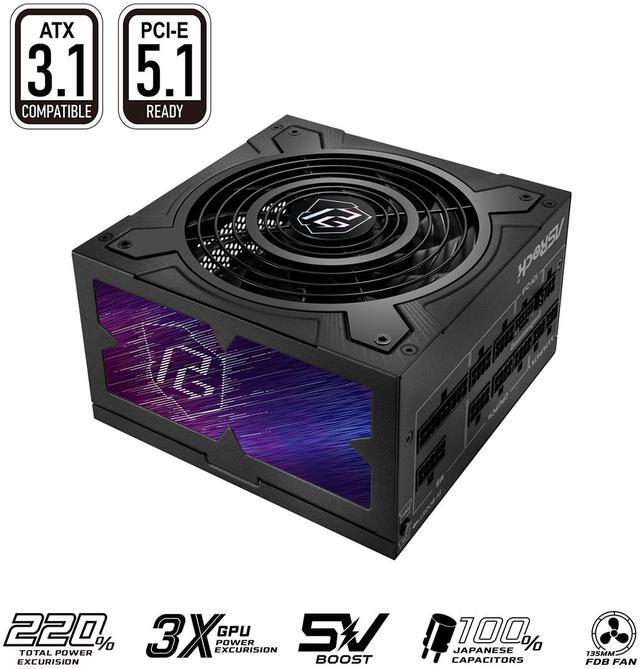
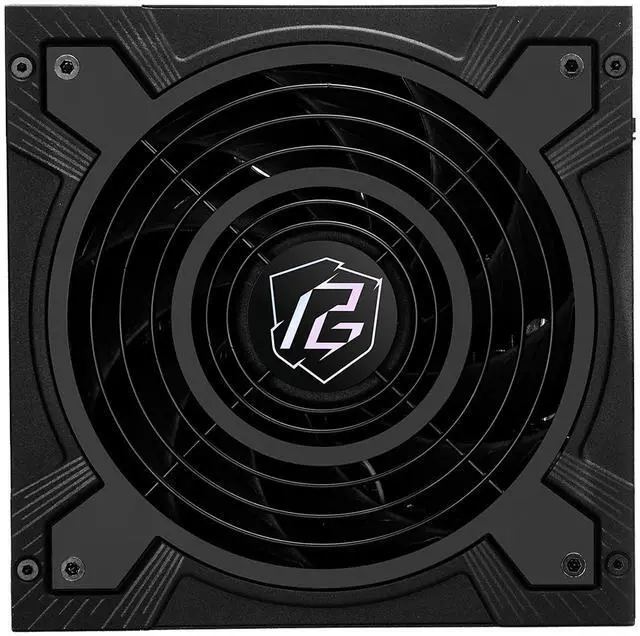
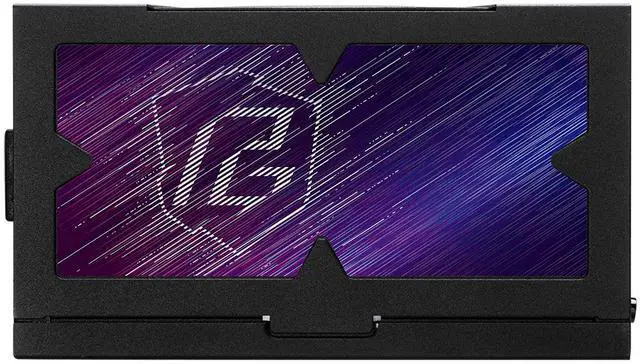
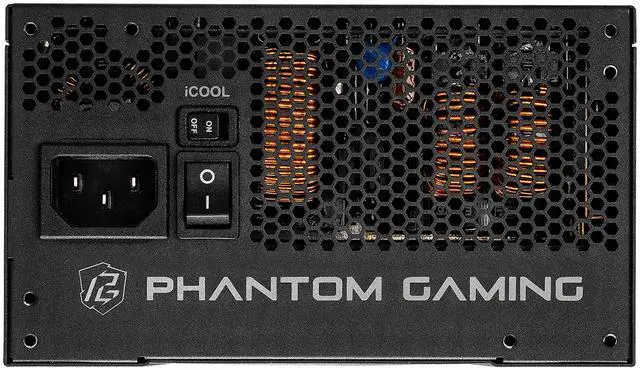
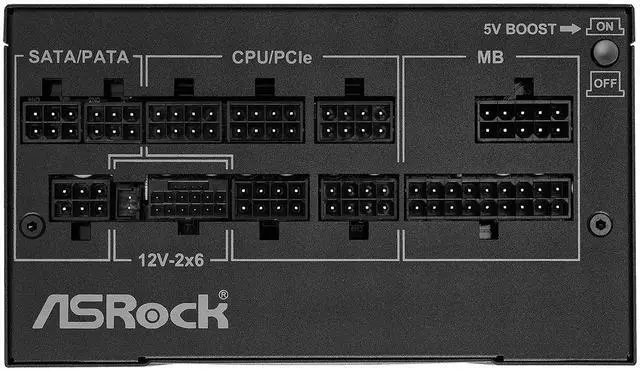
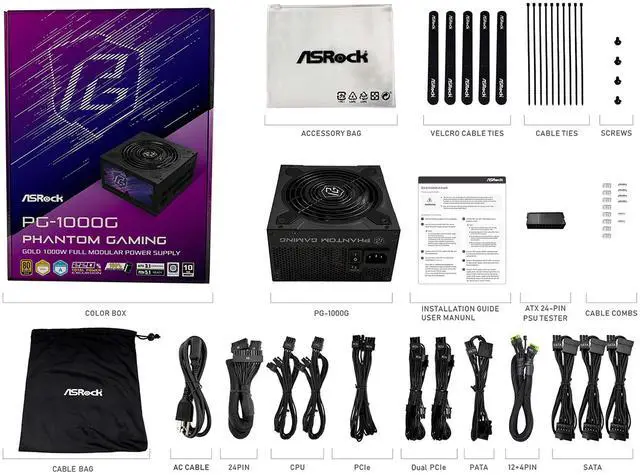
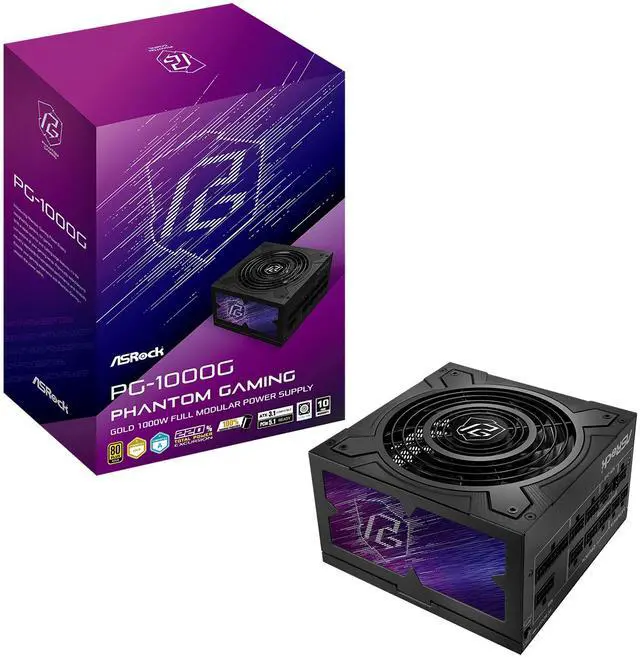
The ASRock Phantom Gaming PG-1000G is a 1000W fully modular ATX 3.1 power supply built for high-performance gaming and creator PCs, especially systems using newer PCIe 5.1 graphics cards that benefit from a native 12V-2x6 connector and strong long-term power headroom.
Recommended For
- Builders pairing a high-end current-gen GPU with an ATX 3.1 PSU and wanting a native 12V-2x6 cable, clear seating check, and cable-temperature monitoring rather than using an adapter.
- PC upgraders who expect to move into a future xx90-class or similar high-draw GPU build and want 1000W headroom now instead of replacing the PSU later.
- Gamers or workstation users who leave their system on for long sessions and care about lower PSU noise at light to medium loads, since the unit offers a semi-passive fan mode and strong Cybenetics acoustic results.
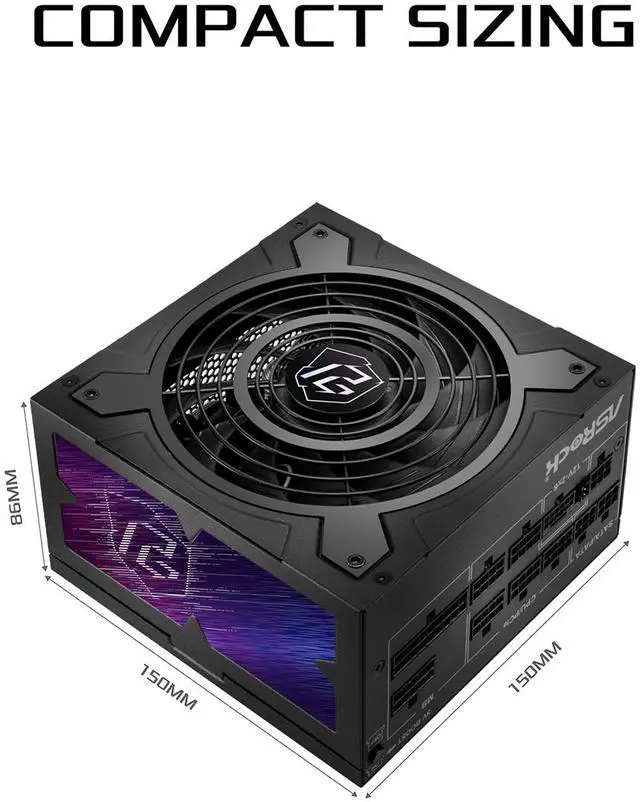
- Mainstream-to-enthusiast ATX builders who want a short standard-depth 1000W PSU with full modular cabling for easier cable routing in typical mid-tower cases.
Real-World Use Scenarios
- Building a high-end gaming PC with one modern flagship GPU: the native 12V-2x6 cable and ATX 3.1 design make setup more direct, and users can expect stable operation for cards in the RTX 5080 / similar class without relying on adapter cables.
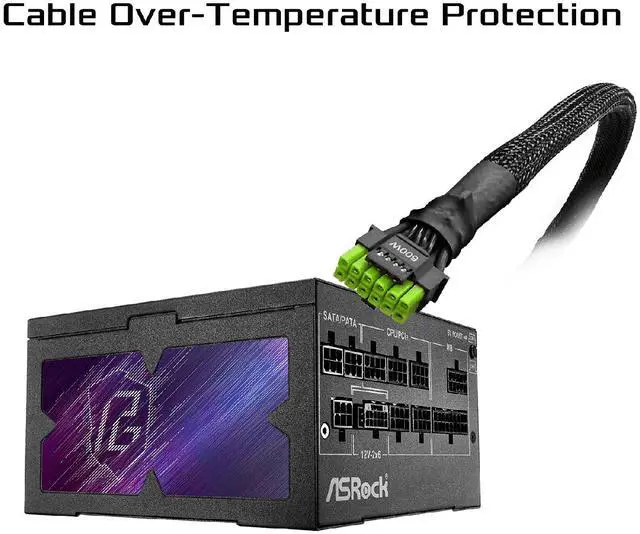
- Upgrading to a next-gen GPU and wanting to avoid 12VHPWR adapter concerns: the included dual-color 12V-2x6 cable helps confirm full insertion, and the TempGuard sensor adds a practical safety layer that users specifically mention as extra peace of mind.
- Running a powerful gaming and productivity system with a high-core-count CPU plus a strong GPU: 1000W capacity gives typical single-GPU builds enough headroom for sustained heavy loads, overclocking, and transient spikes without operating near the limit all the time.
- Using the PC for gaming, work, and general daily use in a quiet room: with iCOOL enabled, the fan stays off at low to medium loads, so the system is often quiet during lighter tasks, though some community reports suggest certain units may produce noticeable noise at very low idle loads.
- Choosing a PSU for a long-term build that may get future GPU upgrades: this model fits users who want one purchase to cover today’s single-GPU system and later PCIe 5.x graphics upgrades, with modular cabling and a 10-year warranty reducing rebuild friction over time.
Spec Summary
| Attribute | Value |
|---|
| Best For | High-power ATX3.1/PCIe5.1 desktop builds that need a 1000 W fully modular power supply |
|---|
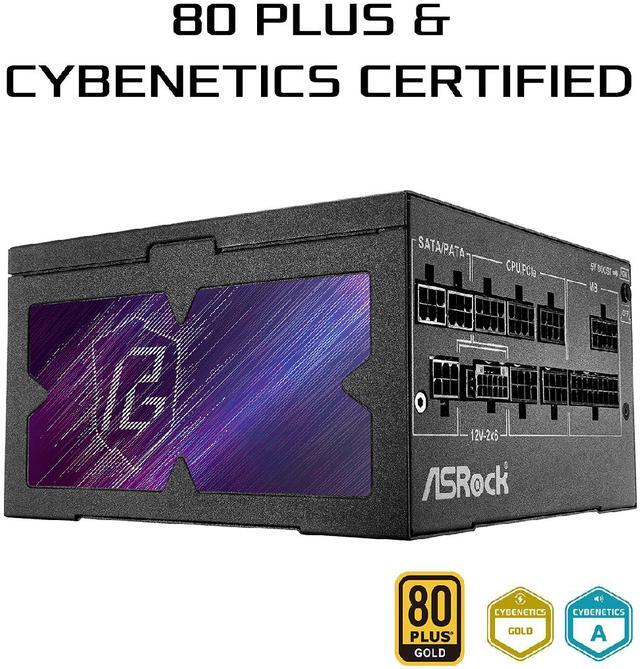
| Power And Efficiency | 1000 W output with Cybenetics GOLD efficiency rating |
|---|
| Connectors And Modularity | Full-modular design with ATX and PCIe connectors, including five 6+2-pin PCIe-style connectors |
|---|
| Cooling And Acoustic | Active cooling via a 135 mm striped axial fluid-dynamic-bearing (FDB) fan; Cybenetics A noise classification |
|---|
| Reliability And Components | MTBF greater than 100,000 hours |
|---|
| Electrical Input/Output | Input voltage range 100–264 V AC; 1000 W output |
|---|
| Physical And Package | Chassis approx 15 x 15 x 8.6 cm; package dimensions 12.9032 x 23.7998 x 31.6992 cm; package weight 3.611 kg; sold as a single unit in black |
|---|
| Compatibility & Platform | Designed for personal computers and compatible with ATX3.1 / PCIe5.1 platforms |
|---|
| Model Identifiers | ASRock PG-1000G; manufacturer/model number 90-UXP085-GFUAAB; style name 1000G |
|---|
Reference Q&A
Q: Should I choose the ASRock PG-1000G or an 850W ATX 3.1 PSU?
A: Choose the ASRock PG-1000G when your build includes a high-end GPU, you want more upgrade headroom, or you prefer a native 12V-2x6 cable with added connector-temperature monitoring. An 850W ATX 3.1 PSU is often sufficient for many RTX 4070 Ti Super and RTX 4080 class systems, but 1000W is the safer fit for power-hungry GPUs, heavier CPUs, and future upgrades. The trade-off is that 850W models can be more cost-efficient for systems that will stay below that power range.
Q: Is the ASRock PG-1000G a better fit than the ASRock Steel Legend SL-1000G?
A: Pick the PG-1000G if you want a gaming-oriented ASRock PSU with its Phantom Gaming positioning and the native 12V-2x6 cable features highlighted by ASRock, including the dual-color connector design and cable temperature sensing. Pick the Steel Legend SL-1000G if you prefer the Steel Legend styling and want a model that has been reviewed with a stronger emphasis on efficiency tuning, including Cybenetics Platinum certification in Tom's Hardware coverage. In practical buying terms, the PG-1000G is the better fit for a performance-focused gaming build, while the SL-1000G is the better fit when you value the alternate styling and slightly stronger efficiency certification.
Q: How does the ASRock PG-1000G compare with the Corsair RM1000x ATX 3.1?
A: Choose the ASRock PG-1000G if you specifically want ASRock's PSU feature set, especially its native 12V-2x6 cable with connector-temperature monitoring and its Phantom Gaming ecosystem alignment. Choose the Corsair RM1000x ATX 3.1 if you prefer a more established PSU family with broad market adoption and similar 1000W, 80 Plus Gold, ATX 3.1 positioning. Both target modern high-end builds, so the decision is less about wattage and more about feature preference, pricing, warranty confidence, and whether ASRock's cable-safety features matter more to you than Corsair's longer-standing PSU track record.
Q: Should I upgrade from an older ATX 2.x 1000W PSU to the ASRock PG-1000G?
A: Upgrade to the ASRock PG-1000G if you are moving to a newer high-power GPU and want native ATX 3.1 and PCIe 5.1 support rather than relying on adapters. The main advantage is not just the 1000W rating, but the newer platform support for power excursions, the native 12V-2x6 connection, and ASRock's added connector-temperature monitoring. If your current 1000W PSU is still modern, high quality, and already meets your GPU cabling needs, the upgrade is more about convenience and standards alignment than raw power.
Q: Is the ASRock PG-1000G worth it over a 1200W PSU?
A: The ASRock PG-1000G is the better choice when you want strong headroom for a single high-end GPU build without stepping up to a larger and often more expensive 1200W class PSU. A 1200W model makes more sense for especially power-heavy combinations, aggressive overclocking, or flagship GPUs paired with top-tier CPUs where vendor guidance moves beyond 1000W. For most premium single-GPU gaming systems, 1000W is the more balanced point; 1200W is mainly about additional margin rather than a different class of everyday performance.
Q: Is the ASRock PG-1000G a good fit for a modern high-end gaming PC with an RTX 40 or RTX 50 series GPU?
A: Yes. The PG-1000G is a strong fit for high-end single-GPU gaming builds because it is a 1000W ATX 3.1 / PCIe 5.1 power supply with a native 12V-2x6 cable, which is the connector buyers repeatedly ask about on comparable retail PSU listings. It makes the most sense for users building around a power-hungry current-generation GPU and wanting a native next-gen cable instead of adapters.
Q: Who should buy a 1000W PSU like the ASRock PG-1000G, and who probably does not need it?
A: The PG-1000G is best for enthusiast desktops with a high-end graphics card, a strong CPU, and some headroom for transient spikes or future upgrades. It is probably more than necessary for mainstream PCs with midrange GPUs, office systems, or compact low-power builds. In short, this is a capacity-first choice for performance desktops, not a value pick for modest systems.
Q: Is the ASRock PG-1000G fully modular, and why does that matter for a buyer?
A: Yes. The PG-1000G is fully modular, which means you only install the cables your system needs. That matters if you want easier cable management, cleaner airflow, and a simpler first build experience. Retail Q&A pages for comparable PSUs show modular design is one of the most repeated buyer checks before purchase.
Q: What are the main trade-offs versus a similar 1000W competitor PSU?
A: The PG-1000G stands out more on practical compatibility and buyer-friendly features than on premium positioning. Its main strengths are ATX 3.1 / PCIe 5.1 support, a native dual-color 12V-2x6 cable, Cybenetics Gold efficiency, Cybenetics A noise rating, Japanese capacitors, and a 10-year warranty. A similar competitor may offer a higher efficiency tier such as Platinum, but often at a higher price or with a shorter warranty. If your priority is current-gen GPU readiness and solid long-term coverage, the ASRock is the more balanced choice; if your priority is maximizing efficiency tier, a pricier Platinum unit may appeal more.
Q: Is the 10-year warranty and low-noise design enough reason to choose this model over a cheaper 1000W PSU?
A: For many buyers, yes. A 10-year warranty, fluid-dynamic-bearing fan, and Cybenetics A noise rating make the PG-1000G a better long-term choice than a cheaper 1000W unit that only matches wattage on paper. If you care about keeping the PSU across multiple upgrade cycles, those durability and noise features are more meaningful than small spec differences elsewhere.
Q: Is the ASRock PG-1000G a good buy for a high-end gaming PC?
A: Yes, it makes sense for a high-end gaming build if you want a 1000W ATX 3.1 power supply with native 12V-2x6 support, full modular cabling, and long warranty coverage. Reddit discussion around this model repeatedly treats it as a serious option for modern GPUs, especially when buyers want extra headroom and the added cable-temperature protection feature. The main trade-off is that it is not the cheapest 1000W unit, and some buyers still compare it against quieter or more established alternatives from Corsair, Seasonic, or Montech.
Q: Who is the ASRock PG-1000G best suited for?
A: It is best suited for builders using power-hungry modern GPUs, buyers who want ATX 3.1 and PCIe 5.1 readiness, and people planning future GPU upgrades. A 1000W capacity is more than many mid-range systems need, so it fits better for upper-midrange to flagship gaming PCs than for budget or modest builds.
Q: Is 1000W overkill for most PCs, or does the PG-1000G still make sense?
A: For many mainstream PCs, 1000W is more than necessary. Reddit discussions around this model often note that 850W is already enough for many systems unless you are using a very high-end GPU or intentionally buying extra upgrade headroom. The PG-1000G makes the most sense if you specifically want margin for future upgrades, lower relative load on the PSU, or a native 12V-2x6 setup for newer graphics cards.
Q: What are the main trade-offs of choosing the ASRock PG-1000G instead of another 1000W PSU?
A: Its main advantages are modern connector support, full modular design, Japanese capacitors, Cybenetics Gold efficiency, Cybenetics A noise certification, and a 10-year warranty. The trade-offs are that community discussion still compares it against better-known PSU brands for long-term reputation, and there are some user reports about noise behavior such as coil-whine-like or fan-related sounds. That does not prove a universal problem, but it is a reasonable consideration if low noise is your top priority.