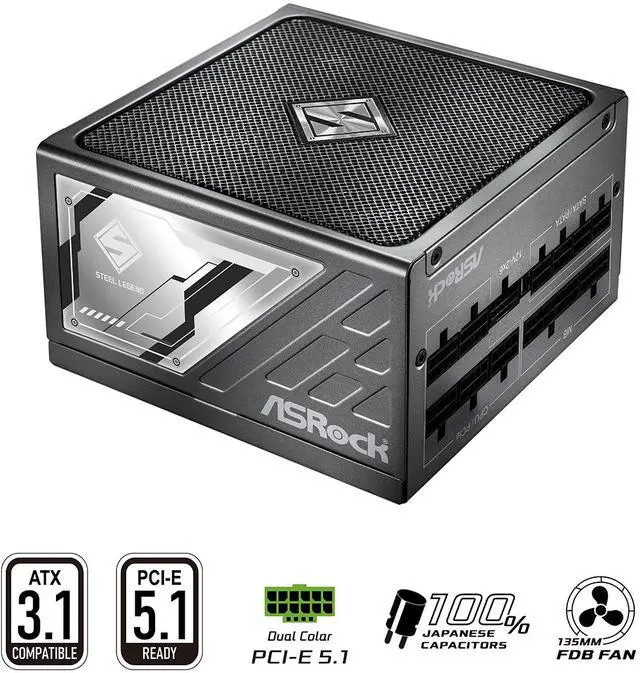
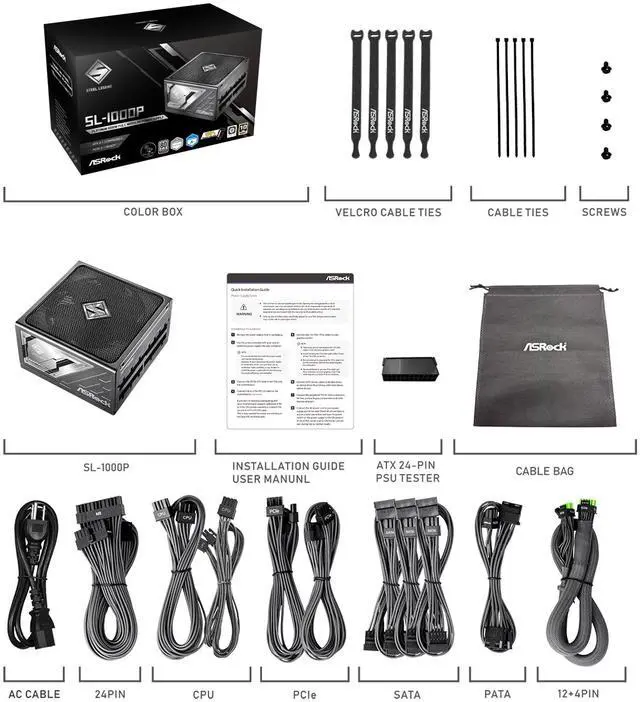
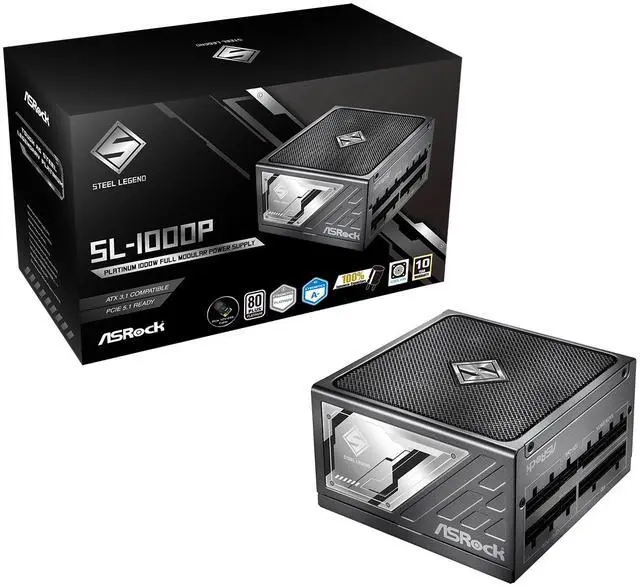
The ASRock Steel Legend SL-1000P is a 1000W fully modular ATX 3.1 power supply built for high-performance gaming or creator PCs that need native 12V-2x6/PCIe 5.1 support, strong efficiency, and long-term reliability in a standard ATX build.
Recommended For
- Builders planning a high-end gaming PC with a next-gen graphics card who want a native 12V-2x6 cable and ATX 3.1 support, instead of using adapters or buying for today only.
- Users intentionally oversizing their PSU for a long upgrade cycle, such as keeping one power supply across multiple AM5 or GPU upgrades over many years.
- Quiet-build users who want a high-wattage PSU that stays unobtrusive at low to moderate loads, including gaming and creator PCs that are idle for long stretches.
- PC enthusiasts comparing value-oriented 1000W options who still want strong efficiency, modular cabling, and modern platform support rather than paying extra for a more established flagship PSU brand.
Real-World Use Scenarios
- Powering a high-end gaming PC with one next-gen graphics card: a builder using a power-hungry GPU and modern CPU can use the native 12V-2x6 cable instead of adapters, with stable operation in gaming loads and cleaner cable routing.
- Building a quiet everyday gaming or creator desktop: with the semi-passive fan mode and low measured noise in reviews, users are likely to notice little or no PSU fan noise during idle, web use, and many moderate-load sessions.
- Running a gaming-plus-workstation system with heavy but realistic peak loads: for users combining a high-core-count CPU, strong GPU, multiple drives, and RGB accessories, reviews indicate it can sustain full rated output and handle modern transient spikes without shutdowns in normal use.
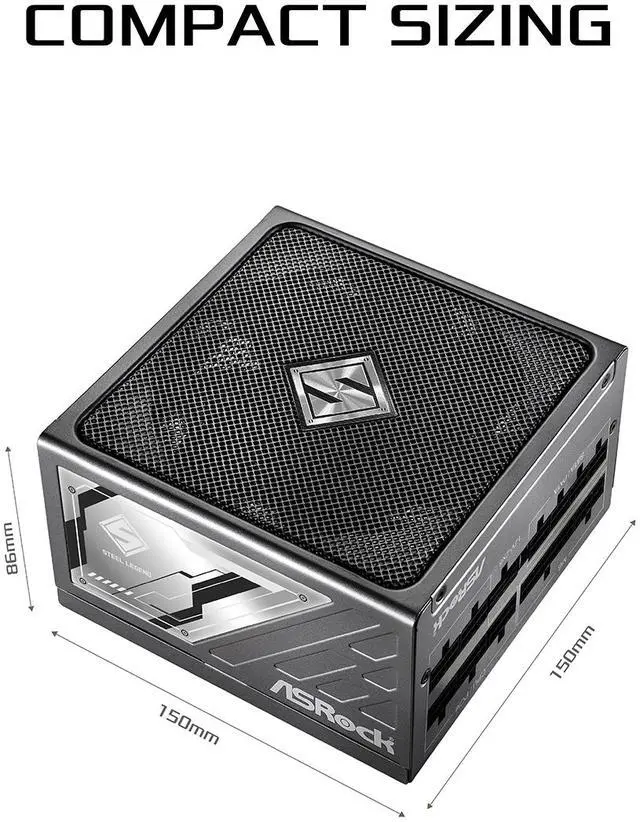
- Choosing a PSU for a clean first-time ATX build: the fully modular design and standard 150 mm depth make cable management and case fitment easier than oversized enthusiast PSUs, so installation is more straightforward in many mid-tower cases.
- Keeping the system for several upgrade cycles: a buyer starting with one upper-midrange GPU today and planning to move to a faster card later is likely to have enough headroom for future single-GPU upgrades, which matches how 1000 W ATX 3.x units are commonly discussed in enthusiast builds.
Spec Summary
| Attribute | Value |
|---|
| Best For | High-performance ATX 3.1 desktop systems and PCIe 5.1 graphics cards, providing a 1000 W output for power-hungry components |
|---|
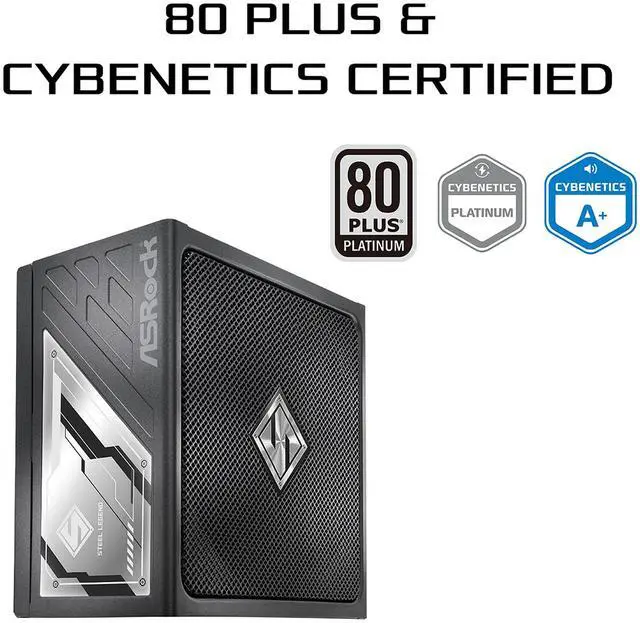
| Power And Efficiency | 1000 W output with 80 PLUS Platinum efficiency |
|---|
| Form Factor And Dimensions | ATX 3.1 form factor; dimensions 150 x 150 x 86 mm (5.91 x 5.91 x 3.39 in) |
|---|
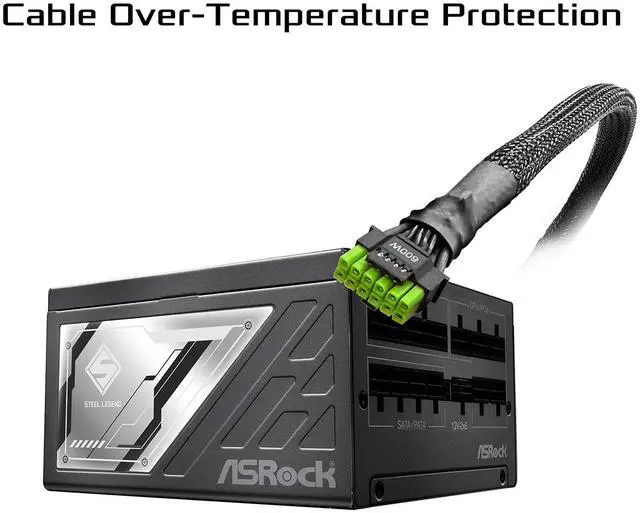
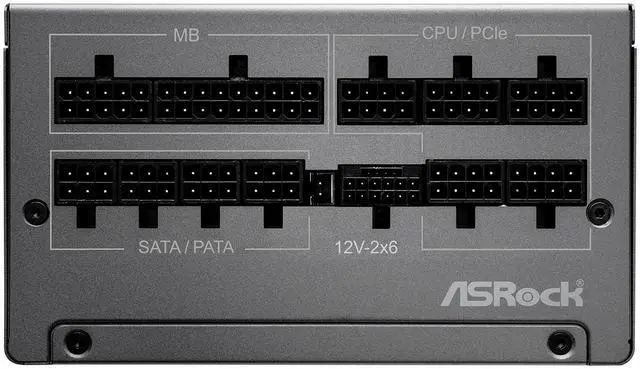
| Connectors And Cables | Fully modular cable set including 1x 24-pin ATX, 1x 4+4 EPS, 1x 8-pin EPS, 1x 12+4 PCIe5.1 (dual-color 12V-2x6), 2x 6+2-pin PCIe, 1x 8-pin PCIe, 3x 4-pin peripheral, and 9x SATA |
|---|
| Cooling And Fans | Air-cooled with a single 135 mm Striped Axial FDB fan |
|---|
| Protection And Safety | Built-in protections: OCP, SCP, OVP, UVP, OTP, OPP |
|---|
| Modular Design | Full modular power supply design (fully modular cable format) |
|---|
| Input Specifications | Universal AC input 100–240 V, 50/60 Hz |
|---|
| Packaging And Weight | Package weight 3.352 kg; package quantity 1; package dimensions 13.208 x 18.796 x 30.988 cm |
|---|
| Model Identifiers | ASRock SL-1000P (Model Number 90-UXS100-PFUAAA), Manufacturer: ASRock, Style Name: 1000P |
|---|
| Compatibility | Designed for personal computers; conforms to ATX 3.1 standard and provides a PCIe 5.1 12+4 connector for supported GPUs |
|---|
Reference Q&A
Q: Should I buy the ASRock SL-1000P or stay with an 850W ATX 3.1 PSU?
A: Choose the ASRock SL-1000P if you want more headroom for a high-end GPU build, future GPU upgrades, or lower average PSU load in a 4080/4090-class system. Stay with a quality 850W ATX 3.1 unit if your build is already well-matched to 850W and you are not targeting higher transient loads or a near-term upgrade. The main trade-off is capacity and upgrade margin: 850W can be sufficient for many current builds, but 1000W is the safer step when users want more buffer around peak spikes and next-GPU flexibility.
Q: ASRock SL-1000P vs Corsair RM1000e: which one makes more sense?
A: Pick the ASRock SL-1000P if your priority is higher advertised efficiency, Cybenetics Platinum certification, and a native ATX 3.1 / PCIe 5.1 feature set in a standard 150mm body. Pick the Corsair RM1000e if case clearance is tighter, because the RM1000e is shorter at 140mm and is easier to fit in more ATX cases. The practical trade-off is efficiency positioning versus compactness and brand familiarity.
Q: Is the ASRock SL-1000P a better fit than the older ASRock SL-1000G?
A: The SL-1000P is the better fit if you specifically want ASRock's newer ATX 3.1 and PCIe 5.1 positioning with a native 12V-2x6 cable approach. The older SL-1000G is still relevant if found at a better price, but it represents ASRock's earlier Steel Legend power-supply generation. For buyers comparing only within ASRock, the decision is mainly new-standard readiness versus deal pricing on the previous model.
Q: Should I get the ASRock SL-1000P or move up to a 1200W PSU?
A: Get the SL-1000P for a single-GPU enthusiast build where 1000W already covers your planned CPU and GPU combination with modern ATX 3.1 support. Move up to 1200W if you want additional margin for very high-end power targets, heavier overclocking, or you prefer to size the PSU more conservatively for future upgrades. The trade-off is simple: 1000W is the more balanced choice for many premium builds, while 1200W is about extra reserve rather than a basic compatibility need.
Q: Is the ASRock SL-1000P a good fit for a high-end gaming PC with a modern Nvidia GPU?
A: Yes. The SL-1000P is a strong fit for high-end gaming builds that use power-hungry current GPUs, especially if you want a native 12V-2x6 cable instead of relying on an adapter. It is ATX 3.1 and PCIe 5.1 ready, provides 1000W capacity, and includes the native GPU connector, so it is better suited to RTX 40/50-class style builds than older 1000W PSUs that only offer traditional 8-pin PCIe leads. It makes the most sense for users building around flagship or near-flagship GPUs, heavy gaming loads, or future GPU upgrades.
Q: Who is the ASRock SL-1000P most suitable for?
A: It is most suitable for enthusiasts building a full-size desktop with a high-end GPU, multiple drives, and a preference for modern power standards. The fully modular design helps with cable management, the 1000W output gives headroom for demanding parts, and the 10-year warranty makes it more appealing for long-term builds than short-upgrade or budget systems. It is less appropriate for entry-level PCs, compact SFX-only cases, or buyers who do not need this much wattage.
Q: What are the main trade-offs versus a cheaper 1000W Gold PSU?
A: The main trade-off is value versus efficiency and feature set. A cheaper 1000W Gold unit can still be enough for many gaming PCs, but the SL-1000P adds a higher efficiency tier, ATX 3.1 support, a native 12V-2x6 cable, Japanese capacitors, quiet-focused fan control, and a long 10-year warranty. The downside is that buyers who just need raw wattage may not notice a large real-world difference compared with a good lower-cost Gold model, so this unit is easier to justify when you care about cleaner GPU cabling, quieter operation, or longer-term platform relevance.
Q: Is the ASRock SL-1000P a quiet PSU for everyday use?
A: For a 1000W desktop PSU, yes. It is designed for quiet operation under lighter and medium loads because it has an intelligent fan control mode that can keep the fan off until load or temperature rises. ASRock also positions it with Cybenetics acoustic certification and a fluid dynamic bearing fan, so it should suit users who want a quieter gaming or workstation build. The trade-off is that, like any PSU, fan noise will still increase under sustained heavy load.
Q: Should you buy the ASRock SL-1000P over an older 1000W PSU that does not include a native 16-pin GPU cable?
A: Usually yes, if you are pairing it with a modern high-power GPU. The biggest practical reason is the native 12V-2x6 connection, which avoids depending on a bundled adapter or older cable layout. That makes the SL-1000P a more current-choice PSU for new builds. An older 1000W unit can still work if it is high quality and your GPU vendor supports an adapter, but it is a weaker choice for cable simplicity, newer compliance, and upgrade readiness.
Q: Is the ASRock SL-1000P worth considering for a high-end gaming PC?
A: Yes, if you want a 1000W ATX 3.1 power supply for a modern high-end GPU build. Reddit discussions around 1000W PSU shopping commonly frame the Steel Legend 1000W models as an option for RTX 5080-class systems because they offer native 12V-2x6 support, full modular cabling, and a 10-year warranty. The main trade-off is that ASRock is still a newer PSU brand than Corsair, Seasonic, or MSI, so some buyers prefer more established PSU lines even when the specs look competitive.
Q: Who is the ASRock SL-1000P best suited for?
A: It is best suited for builders using power-hungry current-generation GPUs, especially those who want a native 12V-2x6 cable and ATX 3.1 compatibility without stepping up to a higher wattage unit. Its 1000W capacity, PCIe 5.1 readiness, and modular design fit gaming or workstation systems with a single flagship GPU. It is less suitable for mainstream builds that do not need this much wattage.
Q: What are the main trade-offs of choosing the ASRock SL-1000P instead of a more established PSU brand?
A: The main advantage is modern feature coverage: ATX 3.1 support, native 12V-2x6, full modular cables, Japanese capacitors, and a 10-year warranty. The trade-off is buyer confidence. In Reddit discussions, hesitation usually comes from ASRock being newer in the PSU category, while competing models from brands like Corsair, MSI, and Seasonic have longer track records and are more commonly recommended by default.
Q: Is the ASRock SL-1000P overkill for most PC builds?
A: Yes, for many mainstream gaming PCs it is more wattage than necessary. Community discussion around similar 1000W PSU choices often centers on pairing them with top-tier GPUs rather than midrange systems. This model makes the most sense when you want extra headroom, are building around a high-draw GPU, or specifically want an ATX 3.1 unit with native 12V-2x6 support.